
Entry & progression
This is the most important lesson in the course. Two routes lead to the same certificate. One costs you six months of sea service. The other costs you thirty. Read the numbers before you plan a single year of your career.
Route A — the structured course
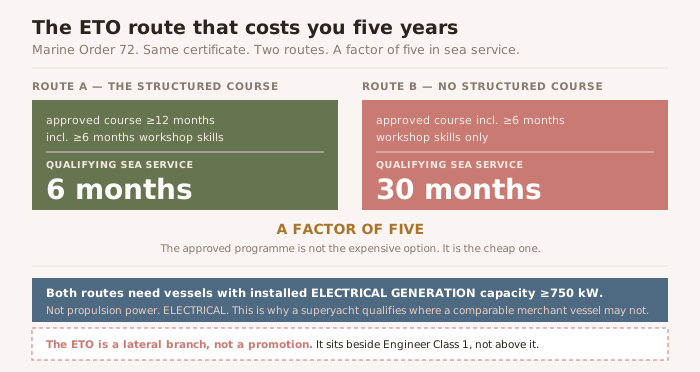
- An approved course of at least 12 months, which must include at least 6 months of workshop skills
- Plus at least 6 months of qualifying sea service, under supervision, documented in a Training Record Book
- The sea service must be on vessels with total installed electrical generation capacity of at least 750 kW
Route B — the unstructured route
- An approved course including at least 6 months of workshop skills (no 12-month course length stated)
- Plus at least 30 months of qualifying sea service in the engine department
- Again on vessels with electrical generation capacity of at least 750 kW
Now look at what you just read
| Route A | Route B | |
|---|---|---|
| Approved course | ≥12 months, incl. ≥6 months workshop skills | Incl. ≥6 months workshop skills |
| Sea service | 6 months | 30 months |
| Supervision + Training Record Book | Required | — |
| Electrical generation capacity | ≥750 kW | ≥750 kW |
Six months, or thirty. A factor of five. The structured route asks you to spend an extra twelve months in an approved programme and gives you back two years of your life at sea. There are very few decisions in a maritime career with that arithmetic attached to them, and almost nobody sits down and does the sum.
Do the sum. If the approved course costs you a year, and the alternative costs you an extra twenty-four months of sea time before you can even apply, the course is not the expensive option. It is the cheap one.
The threshold is ELECTRICAL — and this is why yachts qualify
TIP — 750 kW of generation, not 750 kW of propulsion Every other engineering figure in the Australian system — 375, 400, 500, 750, 1500, 3000 kW — is propulsion power. The ETO threshold is not. It is total installed electrical generation capacity.
That is a completely different measurement, taken from a completely different part of the vessel. It is the sum of what the generating sets can produce, not what turns the shafts. Read the requirement twice; people who skim it plan against the wrong number and lose the time.
Now apply it to a superyacht. Hotel load, air conditioning across every deck, audiovisual, galley, laundry, hydraulics, stabilisers, bow and stern thrusters, and increasingly a hybrid or diesel-electric propulsion arrangement that draws from the same busbars. Yachts carry generating capacity out of all proportion to their length, because the owner's expectation is that nothing ever stops.
The result is that a yacht which would never clear a 750 kW propulsion threshold can clear a 750 kW electrical generation threshold comfortably. That single wording is why the ETO is the one AMSA engineering certificate that a yacht career naturally feeds.
CAUTION — Qualifying is still AMSA's call, not the boat's AMSA has express discretion to discount sea service it considers of little or no relevance, and it states that service on vessels which spend considerable time in port will not be accepted. There is no primary source confirming that AMSA does or does not accept superyacht service toward MO72 certificates.
Clearing 750 kW of generation on paper is necessary. It is not sufficient. Get the vessel's generating capacity documented, get the service letters right, and ask AMSA before you commit years to a plan.