
Entry & progression
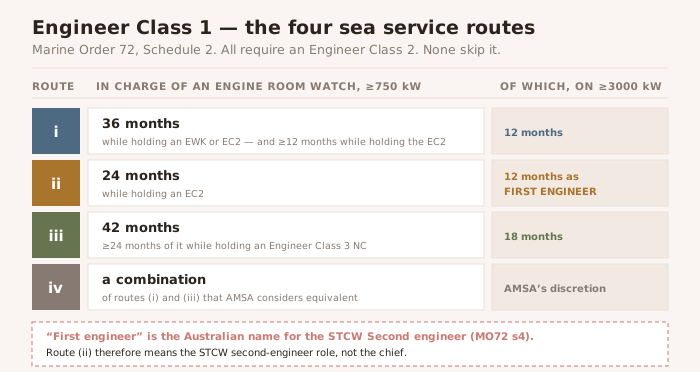
Four routes. All of them start from an Engineer Class 2. Route (ii) is the first engineer route - and in Australia the first engineer is the officer who performs the STCW second engineer functions. Get that backwards and you will log the wrong service.
| Route | Watch service, vessels >=750 kW | The >=3000 kW element | Certificate held while serving |
|---|---|---|---|
| (i) | 36 months while holding an EWK or EC2 | >= 12 months on vessels >=3000 kW, propulsion of the kind | At least 12 months of the 36 while holding an EC2 |
| (ii) | 24 months | >= 12 months as FIRST ENGINEER on vessels >=3000 kW, propulsion of the kind | While holding an EC2 |
| (iii) | 42 months | >= 18 months on vessels >=3000 kW, propulsion of the kind, while holding an EC2 | At least 24 months while holding an EC3 near-coastal or a pre-July-2013 State unrestricted Engineer Class 3 |
| (iv) | A combination of (i) and (iii) that AMSA considers equivalent | - | - |
WARNING — "First engineer" means the STCW second engineer MO72 s4, verbatim: "In the Australian maritime industry, the engineer officer who performs the functions of a Second engineer specified by the STCW Code is generally referred to as the First engineer." AMSA writes it as "First engineer officer (STCW Second engineer)". Route (ii)'s 12 months must be served in that rank - the number two of the department. This is the single most common error in Australian engineering content.
The real constraint is the 3000 kW months
Route (ii) is the shortest at 24 months, but it demands the hardest thing to obtain: a first engineer's berth on a vessel of at least 3000 kW, using your kind of propulsion, all of it while already holding Class 2. Route (i) is 36 months and does not require the rank - but still wants 12 months at >=3000 kW. Route (iii) is 42 months and 18 months at >=3000 kW, and exists for those who came up through the near-coastal ladder.
In every route it is the >=3000 kW months that bind, not the total. Watch time on smaller plant accrues on its own. Time on big plant, of the right kind, in the right rank, while holding the right certificate, does not. Plan the berth before you plan the calendar.
"In charge of an engine room watch"
That phrase is doing work. MO72 Schedule 3 requires service as an engineer, trainee engineer or engineer cadet, "or in an equivalent capacity regularly engaged in engine-room watchkeeping, which may include service on call in periodically unattended machinery spaces on vessels with a propulsion power of >=750 kW". Unattended machinery space duty counts. Simply being aboard does not.
NOTE — Some service is capped MO72 Schedule 3 cl 3.4: service on a non-self-propelled offshore industry mobile unit, on a non-self-propelled dredge while dredging, or on auxiliary machinery run independently of main propulsion is creditable toward Engineer Class 1 to a maximum of 12 months.
Alongside the service you need an approved program of study meeting STCW A-III/1 and A-III/2, including advanced fire fighting, medical first aid and security awareness; a certificate of medical fitness (initial issue in Australia); and the AMSA oral examination - Lesson 4.3.
CAUTION — AMSA publishes no course title for this certificate AMSA names the training only by its STCW reference. It does not publish an AQF qualification title for the STCW engineer certificates, and neither does MO72. Your provider will quote you a course code; what makes it count is AMSA's approval, not the brochure. Confirm with AMSA and the provider before you enrol.