
Entry & progression
One reading is a number. A trend is information. Condition monitoring only pays if somebody is looking at the sequence - and on a rotational yacht, that somebody has to be the system, not the man.
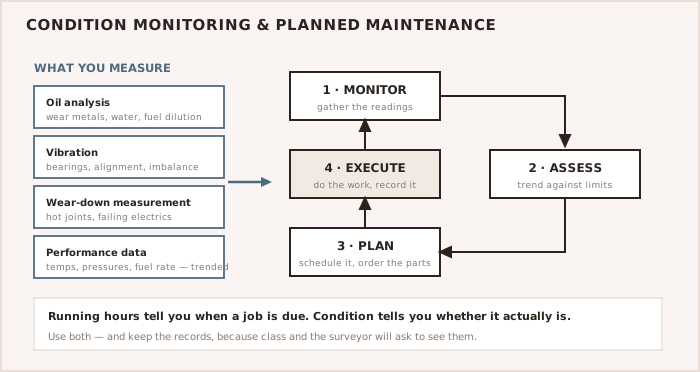
There are three ways to maintain machinery. Run to failure - acceptable for cheap, non-critical, redundant items and nothing else. Calendar or hours-based - the traditional planned maintenance system, which opens up perfectly healthy machinery on schedule and misses the one component that was quietly failing anyway. Condition-based - you measure the machine's health and intervene when it tells you to. The chief's craft is knowing which item deserves which treatment.
Vibration analysis
Overall vibration level tells you something is wrong. The spectrum tells you what.
| Signature | Usual meaning |
|---|---|
| 1x shaft rotational speed, radial | Imbalance - the classic, and the most common |
| 2x shaft speed with a strong axial component | Misalignment - coupling, chocks, or a settled foundation |
| Blade or vane pass frequency | Hydraulic - cavitation, clearance, or flow disturbance in a pump or propeller |
| Bearing defect frequencies, with high-frequency energy | Rolling element bearing - inner race, outer race, ball or cage |
| Sidebands around gear mesh frequency | Gear tooth damage or modulation |
| Broadband, no clear peaks | Looseness, rubbing, or a badly mounted sensor |
TIP — A spectrum without a baseline is decoration You cannot call a peak abnormal unless you know what it looked like when the machine was healthy. Take a baseline on every significant machine after commissioning or overhaul, at a known load, at a marked measurement point. Same point, same load, same direction - every time, or you are comparing nothing to nothing.
The rest of the toolkit
- Lubricating oil analysis. Wear metals identify which component is wearing. Viscosity, water content, TBN and particle count tell you whether the oil itself is still doing its job. Sample from the same point, at the same temperature, at the same interval - and trend it.
- Thermography. Switchboard terminations, bearings, steam and exhaust systems. A loose HV connection shows as heat long before it shows as an arc.
- Ultrasound. Early bearing faults, steam trap function, valves passing, compressed air leaks - all audible above the range of human hearing well before anything is audible within it.
- Performance monitoring. SFOC drift, exhaust temperature spread between units, turbocharger speed at a given load, peak and compression pressures. The engine tells you about itself, in units you already have.
The discipline
The failure of most condition monitoring programmes is not technical. It is that the data is collected and never read. On a rotating crew the problem compounds: the man who took the readings is on leave when the trend turns. The fix is procedural - readings at a fixed interval, at a fixed place, reviewed on a fixed date by the chief, with the trend carried in the handover.
CAUTION — Condition-based maintenance and class Some classification societies will accept an approved condition monitoring scheme in place of certain open-up surveys. The terms are the society's, and they are specific. Confirm with your class society before you assume a survey can be met by a trend chart.