
Entry & progression
Module 2 is the second engineer's real job — and the STCW A-III/2 competences. This is professional engineering craft, not Australian regulation. The AMSA oral will ask you about it in exactly this language.
What a PMS actually is
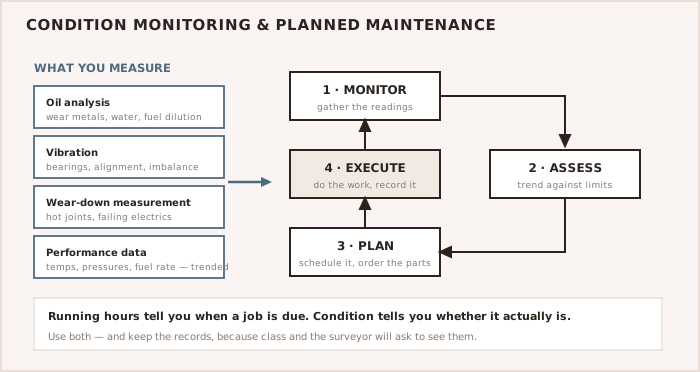
A register of every item of machinery, each with a maintenance interval, a job specification, a spares list and a history. Intervals come from three places: running hours, calendar time, and condition. Most systems mix all three, and most failures happen where the three disagree.
- Running hours — injectors, unit overhauls, turbocharger cleans. Meaningless if the counters are wrong, and on a yacht the counters are frequently wrong.
- Calendar — anodes, hoses, batteries, coolant chemistry, safety valves. These do not care that the boat sat in Palma for six months.
- Condition — vibration, lube oil analysis, insulation resistance, filter differential pressure, exhaust temperature deviation. The only one that tells you the truth about this machine.
The three-tier discipline
How to run a week
- Monday: pull the week's due list. Not the month's. The week's.
- Assign by name, not by rank. A job with no owner is a job that does not happen.
- Close jobs with data, not ticks. Clearances measured, oil pressure recorded, readings written down. A tick tells you nothing in twelve months' time.
- Carry over deliberately. A deferred job gets a reason, a new date and the chief's knowledge. Anything else is an unrecorded defect.
- Review the carry-overs monthly. The list of things you keep deferring is the list of things that will break.
The deferral that becomes a casualty
Every engine room has one. The seawater pump that has been weeping for a year. The auxiliary that only starts on the second attempt. The bilge alarm that was isolated during a charter and never reinstated. None of these are failures yet. All of them are on the way.
The mechanism is always the same. A job is deferred because the boat is busy. The deferral is not recorded, or is recorded and never reviewed. The next second engineer inherits an engine room where a dozen small things are quietly wrong and no one can say how long they have been wrong. Then something stops, at night, in weather, and the casualty report says sudden failure. It was not sudden.
WARNING — A deferral you did not write down is a lie you told the next engineer Deferring maintenance is a legitimate engineering decision. Deferring it silently is not. If you cannot do the job, record: what was due, why it was not done, what the consequence of not doing it is, what compensating check you have put in place, and when it will now be done. Then tell the chief. That is a professional deferral. Anything else is an undocumented defect being handed to someone who trusts you.
Condition monitoring earns its keep
Lube oil analysis, taken properly and trended, is the cheapest diagnostic on the boat. It tells you about bearing wear, fuel dilution, water ingress, coolant leaks and additive depletion — weeks before any of them announce themselves. Sample from the same point, at the same temperature, with the engine running, every time. A sample taken from the bottom of a cold sump is a sample of the sump, not of the oil.
Vibration trending on rotating machinery does the same job. So does a thermal camera on a switchboard. None of it is exotic. All of it is cheaper than a tow.