
Entry & progression
A-III/2 competence: plan and schedule operations; operate, monitor and evaluate engine performance; manage overhaul. The wear tells you a story. Learn to read it.
Before you open anything
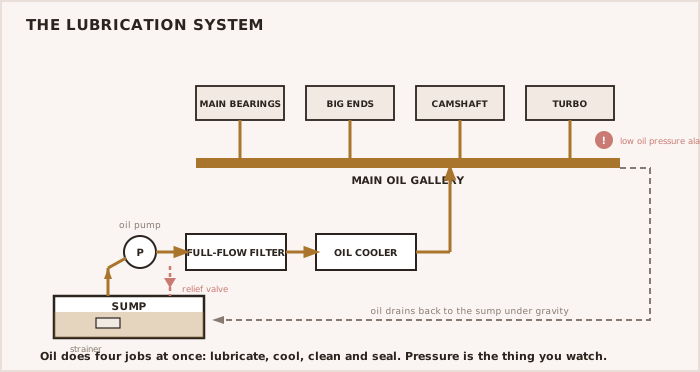
Overhaul preparation
- Read the history. Running hours, last overhaul, oil analysis trend, exhaust temperature deviations, any load restriction.
- Get the manual and the current clearance tables. Not the ones in your head. Manufacturers revise tolerances.
- Confirm the spares are aboard — including gaskets, O-rings, locking devices and single-use fasteners. Especially those.
- Isolate and prove dead: fuel, start air, electrical, cooling water, turning gear engaged, engine on the turning gear locked out.
- Rig the lifting gear and prove the load path before a single nut comes off.
Running gear — what to measure
- Cylinder liner — measure for wear and ovality at multiple heights, top of ring travel included. That is where it wears.
- Piston rings — ring gap in a fixed gauge position in the liner, and groove clearance. Free rings, no collapse, no broken lands.
- Bearings — main, big-end and gudgeon. Measure clearance and inspect the surface.
- Crankshaft deflections — taken cold, at the same positions, and trended. A change in deflection is a change in the hull or the mounts, not in the crank.
- Injector and valve gear — spray pattern, opening pressure, valve seat condition and tappet clearance.
Reading the wear
| What you find | What it usually means |
|---|---|
| Glazed, polished liner | Prolonged light-load running. Rings not sealing. |
| Heavy top-of-stroke liner wear | Corrosive wear — combustion acids, low jacket temperature, water |
| Wiped bearing, one side | Misalignment, or a bent connecting rod |
| Bearing overlay with hard-particle scoring | Contaminated oil — filtration or ingress |
| Burnt exhaust valve seat | Leaking seat, poor lapping, or overfuelling on that unit |
| Carbon on the injector nozzle | Poor atomisation, worn nozzle, or low compression |
WARNING — Light-load running destroys yacht engines A yacht spends its life at anchor, on generators, or idling in and out of marinas. Main engines that never see load glaze their liners, gum their rings, foul their turbochargers and wet-stack. Then the owner asks for full speed and the engine cannot make it. Run the mains under real load, deliberately and regularly, and record it. If the itinerary will not allow it, that is an engineering problem to raise — not a problem to absorb in silence.
Reassembly
Cleanliness is the whole of it. A single particle of grit between a bearing shell and its housing changes the crush and kills the bearing. Clean, lint-free, oiled on assembly, torqued in sequence and in stages, to the current figure, with a calibrated wrench. Angle-tightened fasteners are angle-tightened — a torque wrench alone will not do it.
Then turn it by hand before you turn it by air. Then run it on the turning gear. Then blow through with the indicator cocks open. Then run it light and check for leaks. Then load it slowly, watching exhaust temperatures across the units, and take a full set of readings before you sign it off. Every step exists because someone once skipped it.