
Entry & progression
MO72 Schedule 1 includes electrical, electronic and control engineering duties in the Engineer Watchkeeper entitlement. It is not somebody else's department. This lesson: generators, switchboards, blackout, and recovery.
Generation
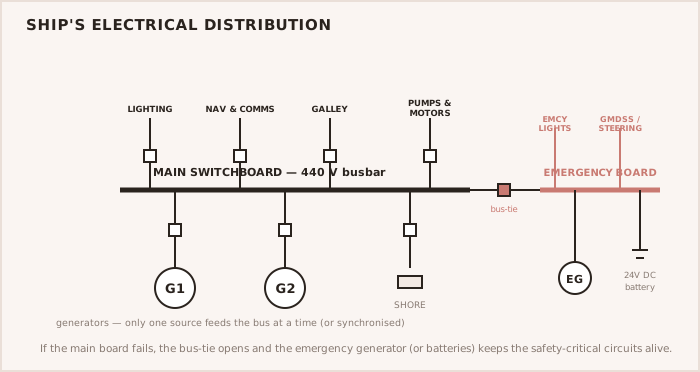
- Diesel generators — a prime mover, an alternator, and a governor that holds the frequency by holding the speed
- AVR — automatic voltage regulator. Holds voltage by controlling excitation. Voltage is excitation; frequency is speed. Keep those two separate in your head and half of the theory falls into place
- Load sharing — droop (each set sheds a little speed as it takes load, so they share naturally) or isochronous (a controller holds exact frequency and actively balances kW between sets)
- Preferential trips — non-essential loads shed automatically on overload, so the board survives. Air conditioning goes before steering does
Paralleling a generator
Bringing a second set onto the board
- Start the incoming set and let it warm and stabilise
- Match the voltage to the running set
- Match the frequency — slightly higher on the incoming set, so it takes load rather than motoring
- Match the phase — synchroscope rotating slowly clockwise, close at the twelve o'clock position, or let the check synchroniser do it
- Close the breaker
- Transfer load until the sets are sharing, and confirm both kW and kVAr are balanced
WARNING — Closing out of phase A breaker closed out of synchronism connects two rotating machines that disagree about where they are. The result is an enormous transient torque through the coupling and the crankshaft and an enormous current through the windings.
It can shear a coupling, bend a shaft, or destroy an alternator in one bang. Trust the check synchroniser, and if you are doing it manually, close at twelve o'clock with the needle turning slowly clockwise — never fast, never anticlockwise.
Earth faults
Most marine distribution is an insulated (IT) system — the neutral is not earthed. A single earth fault therefore does not trip anything. It just sits there, illuminating an earth fault lamp. That is by design: one fault does not stop the ship.
But a second earth fault, on a different phase, is a short circuit through the hull. Find the first one. An earth fault lamp that has been glowing for a fortnight is a blackout waiting for a coincidence.
Blackout and recovery
The emergency generator starts automatically and comes on load — SOLAS requires the emergency source within 45 seconds — feeding the emergency switchboard: steering, emergency lighting, navigation, communications, fire pump.
Recovering from a blackout
- Confirm the emergency generator has started and the emergency board is alive. If not, start it by hand
- Tell the bridge, and get a report of the vessel's situation — proximity, traffic, drift
- Find out why. Do not restart into the same fault
- Check air start pressure. Every restart you make costs you air, and the compressors need power to make more — do not spend your last air on a guess
- Start a generator, close it onto a dead board, and restore essential services in order: cooling and lube oil pumps, then fuel, then the main engine
- Restore non-essential load last, in stages. Do not throw the whole hotel back on in one breaker
Air, power, cooling, fuel. In that order. Get it wrong and you get one attempt.