
Entry & progression
Steering gear is the one machine on board that will put you ashore in minutes. It is tested before every departure, drilled every three months, and it is the engineer's, not the bridge's.
The pre-departure test — within 12 hours of sailing
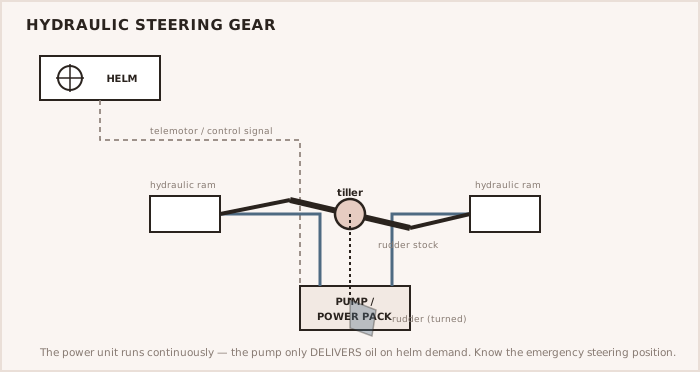
- The main steering gear — full movement, hard over to hard over, and time it
- The auxiliary steering gear, or the second power unit — the same
- The remote control systems from the bridge, every steering position and every mode
- The emergency power supply to the steering gear
- The rudder angle indicators on the bridge, in the steering compartment, and at any remote station — compared against the actual rudder position, not against each other
- The power unit failure alarms and the remote control system failure alarms
- The changeover procedure between power units and between control modes
That last one is the one people skip, and it is the one that matters at 0200 in a traffic separation scheme.
What must be posted
Simple operating instructions with a block diagram showing the changeover procedures must be displayed on the bridge and in the steering gear compartment. Not filed. Displayed. If yours is behind a locker, move it.
Failure modes
| Symptom | Look at |
|---|---|
| Steering slow, sluggish, or short of hard-over | Hydraulic oil level; air in the system; one power unit failed |
| Falling oil level in the tank | A leak. Find it. Low oil is how you lose steering entirely |
| Rudder wanders, hunting, will not settle | Feedback linkage; telemotor / control loop; a failing control valve |
| No response at all from the bridge | Remote control system failure — change to local control in the steering flat |
| Loud knocking under helm | Loose tiller / rudder stock coupling. Stop and look before you use it again |
The emergency changeover
Loss of bridge steering control
- The bridge sounds the alarm and stops or reduces engine as the situation requires
- Both steering power units on — you are no longer economising
- An engineer goes to the steering flat and takes local control — the hand or emergency tiller station
- Establish communications with the bridge: telephone, radio, or a runner. Two ways if you can
- The bridge gives helm orders in degrees of rudder, not courses. The steering flat has no compass and no window
- Every order is repeated back before it is executed, and the execution is reported. Order, repeat, execute, report
- Meanwhile, the fault is diagnosed. Do not restore bridge control until you know why it failed
WARNING — The emergency steering drill is not a paperwork exercise Emergency steering must be drilled at least every three months, and it must include direct control from within the steering gear compartment, the communications procedure with the bridge, and, where fitted, the operation of alternative power supplies.
The first time you stand in a steering flat taking helm orders by radio should not be the day it is real. It is hot, it is loud, you cannot see the sea, and you are entirely dependent on a voice. Practise it properly, with the people who will actually be there.
Nobody has ever regretted testing the steering gear.