
Entry & progression
Your certificate says <3000 GT. Your sea service was measured in metres. Your load line is about freeboard. Three different measuring systems, none of which is a weight, and confusing them is a career-long source of embarrassment.
Gross tonnage is a volume
Under the International Convention on Tonnage Measurement of Ships, gross tonnage is calculated from the total enclosed volume of the vessel:
GT = K₁ × V, where V is the total enclosed volume in cubic metres, and K₁ = 0.2 + 0.02 log₁₀ V.
- It is dimensionless. It is not tonnes, not tons, not weight.
- It measures enclosed volume. Add a superstructure deck, enclose a previously open cockpit in a refit, and the GT goes up — without adding a kilogram of payload capacity.
- It is why builders design so precisely to 499 GT, and why two 50-metre yachts can sit either side of a threshold that changes their entire regulatory life.
- A 2,900 GT yacht very probably displaces far less than 2,900 tonnes.
| Term | What it actually is |
|---|---|
| Gross tonnage | A dimensionless figure derived from total enclosed volume |
| Net tonnage | Derived from the volume of the cargo/useful spaces |
| Displacement | The mass of water displaced — this is a weight |
| Deadweight | The carrying capacity: loaded displacement minus lightship |
| Lightship | The vessel's own mass, empty |
Load line — the freeboard, not the tonnage
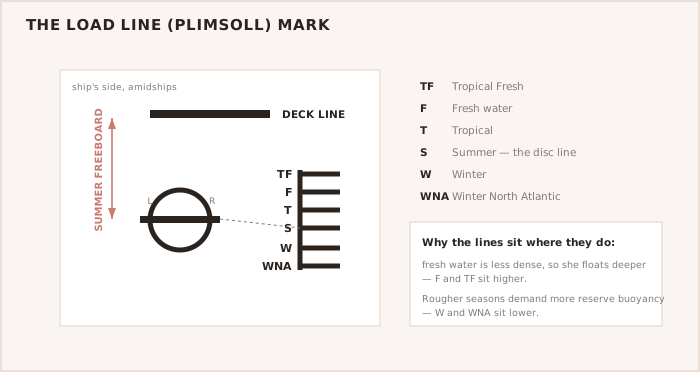
The load line assigns a minimum freeboard: the minimum distance from the deck line to the waterline. Freeboard is reserve buoyancy, and reserve buoyancy is what keeps her afloat when a sea comes aboard. The Plimsoll disc and the marks beside it tell you how deep she may legally be loaded in a given zone and season.
- TF tropical fresh — F fresh — T tropical — S summer — W winter — WNA winter North Atlantic.
- Zones and seasonal areas are charted. The applicable mark is the one for the zone you are in, or will be in, and you must plan for the deepest condition of the voyage — allowing for fuel burned on passage.
- Fresh water allowance — she floats deeper in fresh water. The FWA is on the certificate.
- Conditions of assignment — the freeboard was assigned on the assumption that the closing appliances, hatches, ventilators, air pipes, freeing ports and guard rails were as surveyed. Alter them and you may invalidate the load line.
Two lengths in one Marine Order — a genuine trap
CAUTION — MO74 uses two different definitions of length The 12 m and 20 m sea-service thresholds in MO74 Schedule 2 are overall length. But the 24 m in the Master <200 GT (Yachts) endorsement is load line length, per MO74's own note and Marine Order 1. Two different measures, in one instrument, a few pages apart. If a vessel is near either boundary, do not assume — check which length the provision means, and check what is actually on her certificates.
Why the master cares
Because every threshold in your career is a GT threshold — 200, 500, 3000 — and every threshold in your sea service is a metre threshold, and the load line is neither. A master who cannot say, cold, what his vessel's gross tonnage is, what her load line length is, what her overall length is and what she displaces, does not actually know his ship. Learn the four numbers on the day you join.