
Entry & progression
Security awareness is bundled into the Australian CoST, so you already hold it. This lesson is about what the master does with it — because on most yachts the master is also, in practice, the person the security plan depends on.
The architecture
| Element | What it is |
|---|---|
| Ship Security Assessment | The risk analysis the plan is built on |
| Ship Security Plan (SSP) | The vessel's approved plan; confidential |
| Ship Security Officer (SSO) | Aboard; accountable to the master for the ship's security |
| Company Security Officer (CSO) | Ashore; the Company's security point of contact |
| Port Facility Security Officer (PFSO) | The security officer of the facility you are alongside |
| International Ship Security Certificate (ISSC) | Evidence the vessel complies |
| Ship Security Alert System (SSAS) | The covert alert; it does not sound aboard |
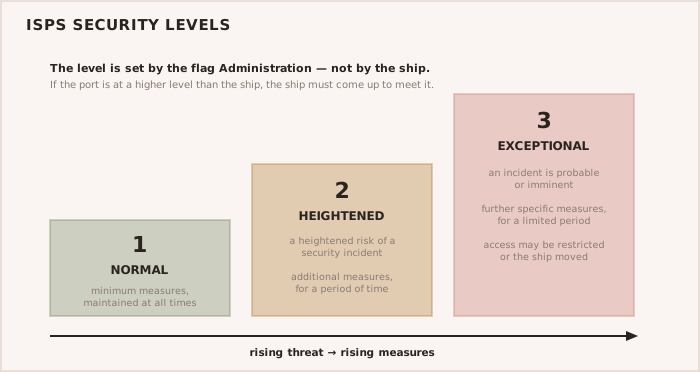
The three security levels
- Level 1 — normal. Minimum appropriate protective measures maintained at all times.
- Level 2 — heightened. Additional protective measures, for a period, because of increased risk.
- Level 3 — exceptional. A security incident is probable or imminent. Further specific measures, for a limited period.
The level is set by the Contracting Government — not by the ship. When a port state raises the level, you comply. Where the ship's level and the port facility's level differ, the higher applies, and a Declaration of Security may be completed to record who is doing what.
Yachts are a specific target profile
A superyacht is a small, valuable, poorly guarded object carrying identifiable wealthy people, frequently alongside in a public marina, with a crew who have been trained to be welcoming. Every one of those characteristics is a vulnerability.
- Access control — one gangway, watched, always. Photo ID, a log, and a crew member who is willing to say no to somebody expensive-looking.
- Contractors and deliveries — the single most exploited route aboard. Verified, escorted, and their bags known.
- Guest and visitor screening — awkward, necessary, and the owner's own security detail will thank you for it.
- Stores and provisions — checked in, not just accepted.
- Restricted areas — bridge, engine room, radio, safes, the owner's accommodation.
- Cyber — the yacht's networks, the guests' devices, the crew's laptops. The modern intrusion arrives over wifi, not over the rail.
WARNING — The security alert is silent, and it must not be tested casually The Ship Security Alert System transmits covertly to the CSO and the flag administration. It does not sound an alarm on board and does not alert other vessels. Know where the activation points are, know who is authorised to use them, and never test it without following the procedure in the SSP — a false SSAS activation consumes real assets and does real damage to your Company's standing.
Piracy and armed robbery
A yacht cannot fight. Its defences are passage planning that avoids the risk, vigilance, freeboard, speed, hardening, and a citadel plan that has actually been drilled. The decision not to transit a high-risk area is a master's decision, and it is protected by the same overriding authority as any other safety decision.
Security is unglamorous and largely invisible when it works. That is what working looks like.