
Entry & progression
Before you sign for a vessel, you must understand how she stays upright — and what you might do that would stop her. Stability is where a master's ignorance is fatal rather than embarrassing.
The three points
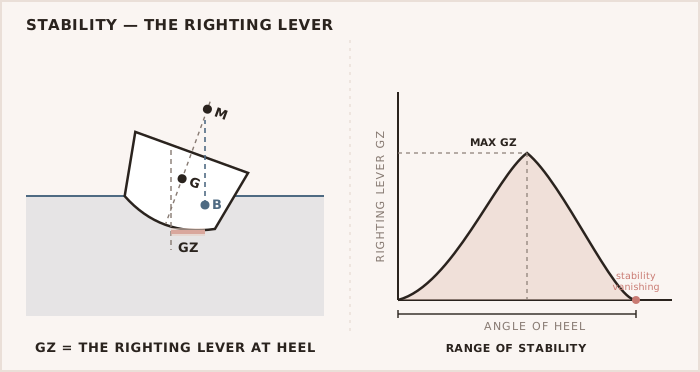
- G — centre of gravity. Where the weight acts. You move it every time you move weight: fuel, water, tenders, toys, guests, a new jacuzzi on the sundeck.
- B — centre of buoyancy. The centre of the underwater volume. It shifts as the vessel heels.
- M — the metacentre. The point about which the vessel effectively rotates at small angles of heel.
GM — the distance from G to M — is the initial measure of stability. Positive GM: the vessel returns upright. Negative GM: she does not, and she will loll to one side and sit there, and she will loll to the other side without warning.
A large GM gives a stiff ship — she snaps back hard, rolls violently, and is unpleasant and hard on structure and people. A small GM gives a tender ship — she rolls slowly and lazily, and she has very little in reserve. Neither extreme is good, and the owner will notice the first one long before the naval architect does.
GZ — the righting lever
GM tells you about small angles. GZ — the righting lever, plotted against angle of heel as the GZ curve — tells you the whole story: the maximum righting lever, the angle at which it occurs, the range of stability, and the angle of vanishing stability beyond which the vessel will not come back.
The area under the GZ curve is dynamical stability — the energy the vessel can absorb. That is what a gust, or a wave, or a hard turn at speed is spending.
Free surface effect — the killer
A partially filled tank does not just add weight. The liquid moves as the vessel heels, and it moves the centre of gravity with it. The effect is a virtual rise in G, and therefore a loss of GM — and it is independent of how much liquid is actually in the tank. A slack tank is a slack tank whether it is 5% full or 95% full.
WARNING — The free surface you did not put there Firefighting water. It goes into a compartment high in the vessel, it does not drain, and it has an enormous free surface. Vessels have been saved from fire and lost to the water used to fight it. Boundary cooling, effective drainage and knowing the free-surface consequences of flooding an interior space are part of fighting a fire — not an afterthought.
The yacht's particular problems
- Weight creep. Yachts accumulate: tenders, jet skis, a submarine, a helicopter, spa equipment, and refit after refit of heavier interior. Almost all of it goes high.
- Large superstructure and windage. A beam gust on a high-sided yacht is a real heeling moment.
- Pools and jacuzzis. Free surface, high up, sometimes full at sea.
- Passenger crowding. Twelve guests all on one side to watch the dolphins is a measurable heeling moment on a small vessel.
- Tender launch and recovery. A suspended weight acts at the point of suspension — the head of the crane, not the deck.
TIP — The stability booklet is not decoration It is approved, it is vessel-specific, and it contains the loading conditions the vessel was actually assessed against. Read it before you take command. If the vessel has been materially modified since it was issued, that is a question for the flag state and the Company, and it is a question you should be asking, in writing, on day one.
You do not need to be a naval architect. You need to know when to stop and ask one.