
Entry & progression
The COLREGs are not a quiz you sit once. They are the operating system of the watch. Rules 5, 6, 7 and 8 apply to every vessel, in every condition of visibility, at all times — and they are where almost every collision is actually decided.
The four rules that never switch off
| Rule | What it says | What it means at 0300 |
|---|---|---|
| 5 — Lookout | Proper lookout by sight and hearing and by all available means appropriate to the circumstances | Your eyes, your ears, your radar, your AIS. Not one of them. All of them. |
| 6 — Safe speed | Speed such that you can take proper and effective action and stop within a distance appropriate to the circumstances | Safe speed is not the speed you booked. It is the speed the conditions allow. |
| 7 — Risk of collision | Use all available means; use radar properly including long-range scanning and plotting; assumptions on scanty information are forbidden | A steady compass bearing at decreasing range means risk exists. Assume it exists if in doubt. |
| 8 — Action to avoid | Action must be positive, made in ample time, with due regard to good seamanship, and large enough to be readily apparent to the other vessel | Ten degrees is not an alteration. It is a rounding error on his radar. |
Rule 7, and the sin of the scanty fix
Rule 7(c) is the sentence that hangs more watchkeepers than any other: assumptions shall not be made on the basis of scanty information, especially scanty radar information. One AIS name. One unplotted echo. A vessel you have decided must be a fishing boat because it is where fishing boats usually are. That is scanty information, and Rule 7 says you may not build a decision on it.
The test for risk of collision is the compass bearing. If the compass bearing of an approaching vessel does not appreciably change, risk of collision exists — and it can exist even when the bearing is changing, with a very large vessel, a tow, or a vessel at close range. Take the bearing. Take it again. Take it a third time.
Rule 8 — make it obvious
Small alterations are the currency of the near-miss. A ten-degree alteration on a converging course is invisible to the other watchkeeper, changes the CPA by almost nothing, and leaves both of you inside a developing situation with less sea room than you had. Alter big, alter early, and alter once.
A succession of small alterations, or small changes of speed, is expressly warned against. And if you have room, an alteration of course alone is the better action — it is visible, it is unambiguous, and it does not depend on the other vessel noticing your bow wave die away.
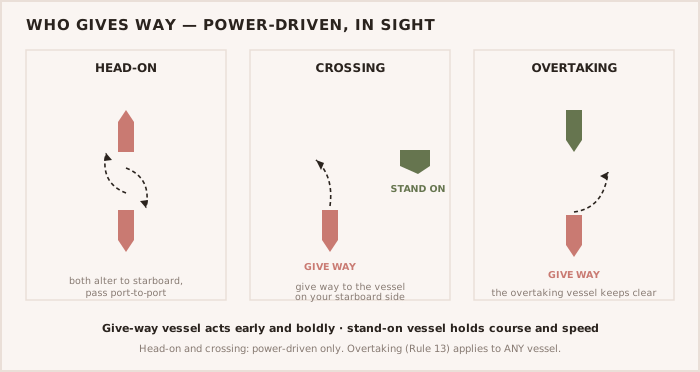
WARNING — Give-way and stand-on are not permissions to stop thinking If you are the stand-on vessel, you may — and eventually must — take action when it becomes apparent the give-way vessel is not acting. And whatever the rules say about who gives way, Rule 2 means no rule ever excuses neglect of any precaution required by the ordinary practice of seamen. There is no rule that entitles you to be run down correctly.
On a fast yacht
A 25-knot yacht compresses every timescale. A target that is 12 miles away is fifteen minutes away, not thirty. Safe speed under Rule 6 explicitly accounts for manoeuvrability, stopping distance and turning ability — and a planing hull at speed has less of all three than her crew imagines.