
Entry & progression
The oral examiner will not ask you whether you can press a button. He will ask you what you would do when the button stops working. Position fixing is the competence that sits underneath every other navigational competence, and it is chronically neglected.
The position line
Everything reduces to the position line: a locus on which the vessel lies. Cross two and you have a fix. Cross three and you have a fix and a check — the cocked hat, whose size is the honest measure of how much you should trust the answer.
| Method | Gives you | Its weakness |
|---|---|---|
| Visual compass bearing | A position line through a charted object | Compass error; misidentified object; distance |
| Radar range | A circular position line — usually the most accurate line radar gives | Poor discrimination on low, sloping or featureless coast |
| Radar bearing | A position line | Beam width makes it far less accurate than the range |
| Transit | A position line with no instrument error at all | You only get it where two objects happen to line up |
| Echo sounder | A contour line, and a superb independent check | Only useful against distinctive bathymetry |
| GNSS | A position, continuously, to metres | One system, one failure mode, no seamanship |
TIP — Radar range beats radar bearing. Every time. A radar range is accurate to a small fraction of a mile. A radar bearing is smeared by the horizontal beam width and may be a degree or more out. Given a choice, fix by three radar ranges rather than three radar bearings — and if you must mix, take the range from radar and the bearing by eye.
Choosing your objects
- Positively identify every object before you use it. A misidentified light is worse than no light.
- Spread the cut. Two position lines crossing at a fine angle produce an enormous error for a small mistake. Aim for a good angle of cut — 60 to 90 degrees between lines, and objects well spread around you.
- Take the fastest-changing bearing last, and the slowest-changing first. The beam bearing changes quickest; the ahead-and-astern bearings barely move.
- Plot immediately. A bearing in your head is not a position line.
The cocked hat
Three lines rarely meet at a point. The triangle they form is telling you something. A small cocked hat means small random errors. A large one means something is wrong — a compass error you have not applied, an object you have misidentified, a time lag between the first bearing and the third. Do not average a large cocked hat away. Find the cause.
And when there is danger nearby, assume you are at the corner of the cocked hat closest to the danger. That is not pessimism. It is the only assumption that costs nothing if you are wrong.
Estimated position and dead reckoning
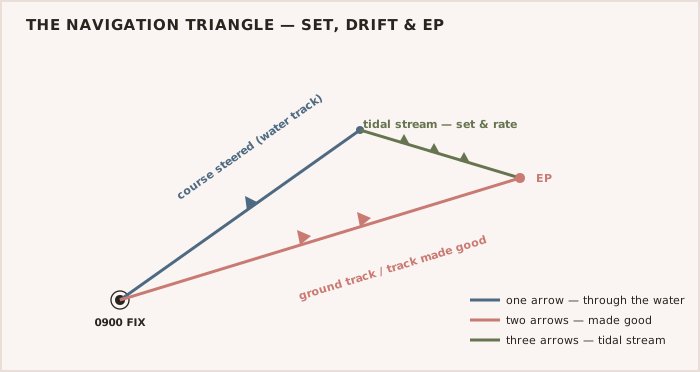
DR is the position from course steered and distance run — no set, no drift, no leeway. EP applies the tidal stream and the leeway to that. Neither is a fix. Both are what you have when the fix fails, and both are only as good as the discipline you kept when you did not need them.
WARNING — The paperless bridge fails silently GNSS does not go blank. It goes wrong — jammed, spoofed, or drifting — while looking exactly as confident as it did an hour ago. The only thing that catches it is an independent check: a visual bearing, a radar range, a transit, an echo sounder trace that does not match the chart. Keep a running plot on a real chart. On a yacht, nobody will make you. Do it anyway.