
Entry & progression
Course: RYA/MCA Approved Engine Course 1 — a short, practical introduction to the small marine diesel for skippers and crew, so they can operate the engine, carry out routine care, and diagnose and fix the most common problems at sea. Entry: none — no prior engineering knowledge assumed. Progresses to AEC 2 and, for those pursuing engineering as a career, the Marine Engine Operator Licence and the small-vessel engineering CoCs.
Compression ignition
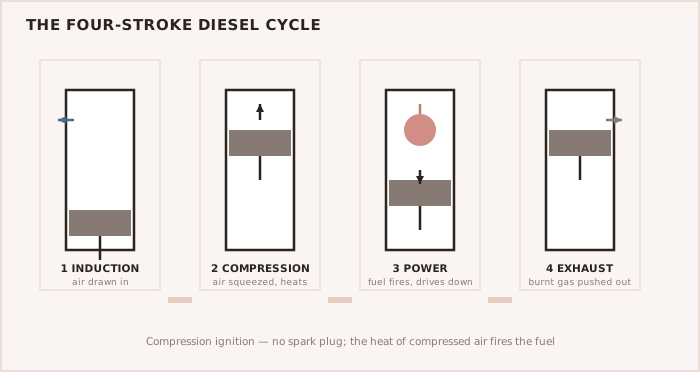
A diesel engine draws in air, compresses it hard enough to make it very hot, then injects a fine spray of fuel that ignites on contact with that hot air — there is no spark plug, which is the key difference from a petrol engine. The burning gas pushes the piston down, and the connecting rod and crankshaft turn that up-and-down motion into rotation. Most small marine diesels are four-stroke engines, completing the cycle in four strokes of the piston (two turns of the crankshaft): induction, compression, power and exhaust.
- Induction — the piston descends, drawing air into the cylinder through the inlet valve.
- Compression — the piston rises with the valves closed, squeezing and heating the air.
- Power — fuel is injected into the hot compressed air, ignites, and drives the piston down.
- Exhaust — the piston rises again and pushes the burnt gas out through the exhaust valve.
What the engine needs
A diesel needs three things to run, and almost every failure to start or run traces back to one of them: clean air in sufficient quantity, clean fuel delivered at the right time and pressure, and good compression to make the air hot enough to ignite the fuel. Keeping those three healthy — a clear air filter, clean fuel and filters, and a sound engine — is what keeps a diesel reliable.
NOTE — Air, fuel, compression A diesel runs on three things: clean air, clean fuel at the right time, and good compression. When one is missing the engine will not start or run well, and that is where fault-finding begins.
TIP — Learn your own engine Spend time with your engine's manual and identify the parts by sight, so that when something goes wrong you know where to look and what normal looks like.