
Entry & progression
This course does not teach Basic Training. The library already covers PST, FPFF, EFA and PSSR. This lesson tells you which of Australia's two certification systems you are standing in — because the answer changes every rule that follows.
Australia does not have a seafarer certification system. It has two. They sit under two different Acts, are given effect by two different sets of Marine Orders, cover two different classes of vessel, and measure a ship in two different units. One regulator, AMSA, administers both. Conflating them is the single easiest way to get Australian certification wrong, and almost everyone does it at least once.
The two Acts
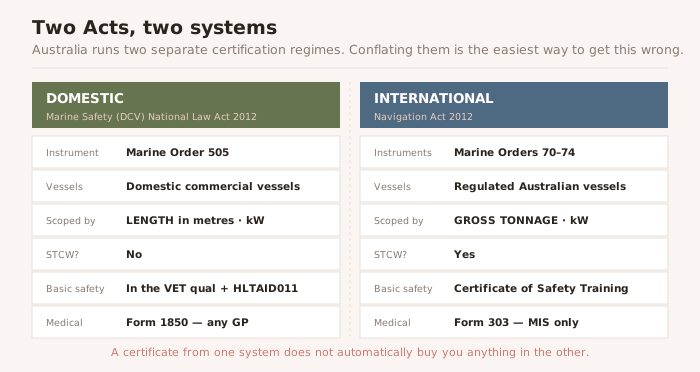
The domestic system sits under the Marine Safety (Domestic Commercial Vessel) National Law Act 2012. Its certificates of competency come from Marine Order 505. It applies to domestic commercial vessels — DCVs. It is not an STCW system, and it issues nothing the rest of the world is obliged to recognise.
The international system sits under the Navigation Act 2012. Its certificates come from Marine Orders 70, 71, 72 and 74. It applies to regulated Australian vessels. It is an STCW system, and the certificates it issues are the ones that travel.
| Domestic | International | |
|---|---|---|
| Act | Marine Safety (DCV) National Law Act 2012 | Navigation Act 2012 |
| Instrument | Marine Order 505 | Marine Orders 70, 71, 72, 74 |
| Vessels | Domestic commercial vessels | Regulated Australian vessels |
| Scoped by | Length in metres and kilowatts | Gross tonnage (deck) / kilowatts (engineering) |
| STCW? | No | Yes |
Metres and kilowatts, or gross tonnes
The domestic system scopes a ticket by length in metres and by propulsion power in kilowatts. A Coxswain Grade 1 is a vessel under 12 metres with an inboard engine under 500 kW. Tonnage does not appear.
The international system scopes deck certificates by gross tonnage — Master less than 500 GT, Master less than 3000 GT — and scopes engineering certificates by kilowatts, never tonnage. There is no GT figure anywhere in Marine Order 72. There is no certificate called "Engineer less than 3000 GT". If you see that phrase, whoever wrote it was guessing.
Where the two systems touch
They touch in one direction only. Marine Order 505 recognises holders of STCW certificates for corresponding near-coastal duties — so an international ticket buys you something domestic. Nothing runs the other way. There is no provision anywhere that converts a domestic certificate into an STCW one. Module 3 walks that crosswalk in detail, including the part that will surprise you.
Why a yacht crew member should care
If you work a charter yacht on domestic voyages under the National Law, you are in the metres-and-kilowatts world and your ticket comes from MO505. If the yacht is a regulated Australian vessel trading internationally, you are in the gross-tonnage world and your ticket comes from MO74. The same hull can move between the two systems across a season. Your certificate cannot.
CAUTION — Ask which Act before you ask anything else Every question in Australian certification — what ticket, what sea service, what medical, what letter, what course — has two different answers depending on which Act you are under. Answer the wrong one and you will do the right paperwork for the wrong system. If you are not certain which system a job sits in, ask the operator, and confirm with AMSA before you spend money on a course.
So the first question is never "what ticket do I need". It is "which Act am I under". Get that wrong and every other answer is wrong with it.