
Entry & progression
"Near coastal" sounds like a limit. It is not. It reaches to the outer edge of Australia's exclusive economic zone. This lesson kills the most persistent myth in Australian domestic certification.
The definition
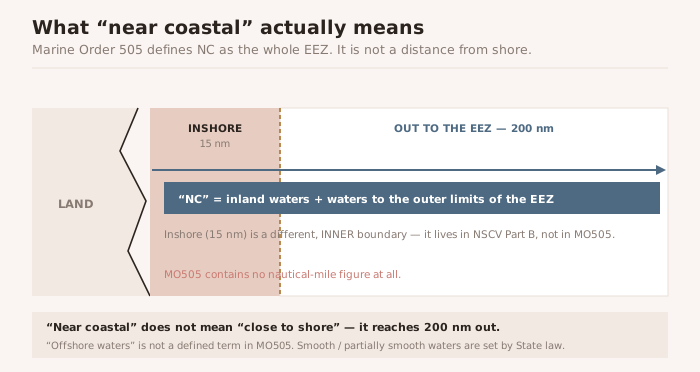
MO505 defines near coastal (NC) waters as waters including inland waters and waters to the outer limits of the exclusive economic zone of Australia. That is it. Not a distance. Not a horizon. The whole EEZ. A near-coastal certificate can carry you hundreds of miles offshore and still be exactly what it says on the card.
This is not a technicality. An Engineer Class 3 near coastal may act as chief engineer on a vessel with an inboard engine under 3000 kW to the outer limits of the EEZ. A Master less than 24 m NC may command to the EEZ. A Sailing Master Offshore NC may take a sailing vessel under 24 metres to the EEZ. "Near coastal" carries far more authority than the phrase suggests.
Then where does 15 nautical miles come from?
It is real, but it is not in MO505 and it is not the definition of near coastal. MO505 defines inshore waters as inland waters and waters landward of the outer limits for inshore operations. The 15 nm figure that people quote lives in the National Standard for Commercial Vessels, Part B — a vessel-side standard, not a crewing instrument.
So when a Coxswain Grade 1 is described as an inshore-waters ticket, the boundary of "inshore" is set elsewhere and it is not the same boundary as "near coastal". Two words, two different geographies, one Order.
Smooth and partially smooth waters
These are the most locally variable areas in the system, and there is no Commonwealth nautical-mile figure for them at all. Smooth and partially smooth waters are designated under State and Territory law. A stretch of water that is partially smooth in one jurisdiction is not automatically partially smooth in the next.
CAUTION — Do not carry a number across a border There is no single national figure for smooth or partially smooth waters. The designations sit in State and Territory instruments and they differ. If your operation depends on where the smooth-water line falls — and for a small charter yacht it very often does — check the designation for the specific State you are working in, and check it against the vessel's certificate of operation. Do not rely on what was true in the last port.
Two phrases that are not defined at all
"Offshore waters" and "near coastal waters" are not defined terms in MO505. People use them constantly. The Order does not. When you see them in a job ad or a training brochure, treat them as marketing language and ask what operational area the vessel's certificate of operation actually specifies.
What this means for you
The practical lesson is a reading habit. In the domestic system, the area a ticket covers is a defined term, and the definition is not always the intuitive one. Near coastal is the EEZ. Inshore is narrower and is fixed by a different document. Smooth water is a State question. Offshore is not a word the Order knows.
Before you accept a job on the strength of a certificate, read what the certificate's operating area is defined as — not what it sounds like.