
Assessing risk of collision
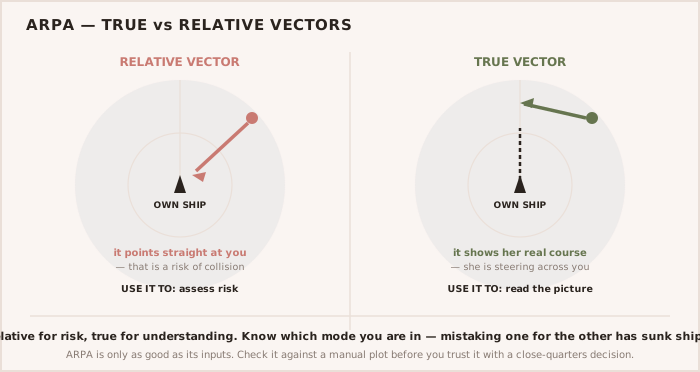
By plotting a target — manually, or automatically with ARPA — the officer finds its closest point of approach (CPA) and the time to it (TCPA), and its true course and speed. A steady compass bearing with a decreasing range means risk of collision exists. ARPA automates this, continuously displaying vectors and warnings, but it has limitations: it can swap or lose targets in clutter, there is a delay after any manoeuvre before its vectors settle, and it is only as good as the radar and sensor inputs feeding it. Radar and ARPA inform the decision; the collision regulations and the lookout make it.
- Understand CPA and TCPA and how to obtain them by plotting or from ARPA.
- Use ARPA acquisition, tracking, vectors and the trial-manoeuvre function correctly.
- Know ARPA's limitations: target swap, tracking errors, the manoeuvre delay, and dependence on good inputs.
- Apply the collision regulations — the radar informs, the rules and the lookout decide.
WARNING — Aids inform; the rules and the lookout decide ARPA gives the CPA, TCPA and target motion, but Rule 7 warns against assumptions on scanty information and no rule lets you hand the decision to a box. Confirm with radar and eyes, then act under the collision regulations.
TIP — A steady bearing is the warning A target whose compass bearing does not change while the range closes is on a collision course. That is the signal to assess and act early, whether the bearing is read by eye, by radar or from ARPA.