
Principles and setting up
Radar transmits pulses of radio energy and times the returning echoes to measure the range and bearing of targets. Range discrimination and minimum range depend on the pulse length; bearing discrimination depends on the horizontal beam width. The picture is degraded by sea clutter close in, rain clutter in showers, interference and false echoes such as side-echoes and multiple reflections. X-band (3 cm) gives sharper definition and better detection of small targets and racons; S-band (10 cm) penetrates rain and sea clutter better and holds targets in bad weather. The OOW tunes gain and the sea and rain clutter controls to the conditions rather than leaving them on automatic when returns are difficult.
Radar plotting and the relative-motion triangle
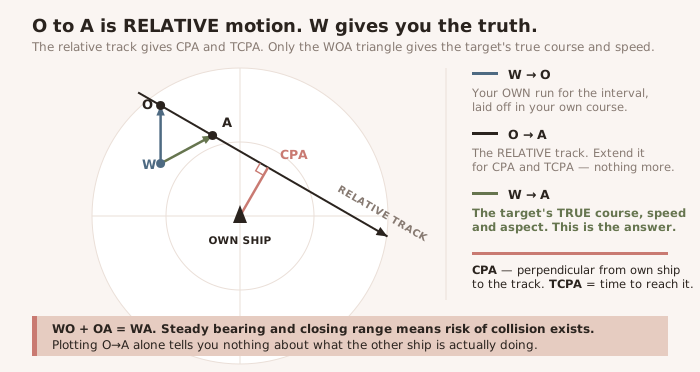
Plotting a contact (the OAW / WO triangle)
- Plot the target's position at three timed intervals to establish its relative track (O to A).
- Extend the relative track to read the closest point of approach (CPA) and measure the time to it (TCPA).
- Draw WO representing your own vessel's course and speed for the interval.
- Complete the triangle: WA gives the target's true course, speed and aspect.
- Decide whether a risk of collision exists and what alteration removes it, applying the IRPCS, then re-plot to confirm the CPA has opened.
The CPA (the minimum distance the target will pass) and the TCPA (the time until that closest approach) are the two numbers that decide whether risk of collision exists. A steady compass bearing with decreasing range means risk exists. Radar plotting also reveals the target's true course and speed, which the IRPCS require you to know before deciding on action.
WARNING — Early, large and obvious — then check Small, late alterations are dangerous and hard for another ship to detect on radar. Make an early, substantial and obvious alteration of course or speed, and re-plot to confirm the CPA has actually opened before you relax.
NOTE — Match the band to the weather Fit and use X-band for definition and small-target detection in clear conditions; S-band earns its place in rain and heavy sea clutter when X-band goes blind.