
Under power
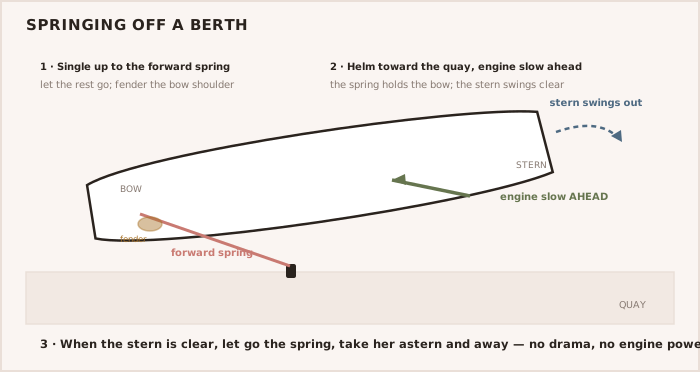
The skipper works with four forces at once: the thrust and the transverse 'paddle-wheel' effect of the propeller, the rudder, and the wind and tide acting on the hull and the rig. The boat turns about a pivot point roughly a third of the way aft, and short bursts of power against a held rudder ('prop-walking' and using the wash over the rudder) let her be turned almost in her own length. Berthing and unberthing use springs and lines to hold and pivot the boat against the elements rather than fighting them with engine alone.
Under sail
- Trim the sails for the point of sailing and reef early so the boat stays balanced and controllable.
- Handle the boat through tacking, gybing, heaving-to, and coming onto and off a mooring or anchor under sail.
- Know the boat's turning circle, her stopping distance, and how she behaves as the wind builds.
- Keep the boat balanced — a well-trimmed boat almost steers herself; a badly trimmed one fights the helm.
Man overboard recovery (the skipper's set-piece)
- Shout 'man overboard', throw a danbuoy or lifebuoy, and press the MOB button on the GNSS.
- Detail one crew member to point continuously at the casualty and never lose sight of them.
- Return by a practised method (under power, or reach-tack-reach under sail) to approach from downwind and stop alongside.
- Recover the casualty aboard, treat for cold and shock, and make a distress call if needed.
WARNING — Reef early, before you have to Everything on deck gets harder once the boat is overpowered. Reduce sail while it is still easy; a boat that is over-canvassed is hard to handle, heels excessively and puts the crew at risk.
TIP — Use the wind and tide, don't fight them Plan a berthing approach so wind and tide help you stop and lie alongside. A slow approach with an escape route beats a fast one you cannot abort.