
Entry & progression
Remember what the CFR is measuring: propulsion power is the main propulsion machinery only — 46 CFR 10.107 excludes thrusters and other auxiliary machinery. The engines in this lesson are the ones that set your horsepower limitation under 11.503(b).
The four systems that keep a diesel alive
| System | What it does | How it kills the engine |
|---|---|---|
| Fuel | Delivers clean fuel at the right pressure and timing | Water and particulates destroy injection equipment; poor combustion wrecks liners and valves |
| Lubrication | Separates metal from metal; carries away heat and debris | Loss of pressure seizes bearings in seconds; contamination does it slowly |
| Cooling | Removes roughly a third of the fuel energy as heat | Overheating distorts, cracks and scuffs everything it touches |
| Air and exhaust | Supplies combustion air and removes exhaust gas | Restriction starves combustion; a failing turbocharger takes the power with it |
Almost every diesel failure you will ever see traces back to one of those four, and usually to contamination or restriction inside one of them.
Fuel — where the trouble lives
- Water is the enemy. It arrives with the bunkers, it condenses in the tanks, and biological contamination grows at the fuel/water interface.
- Bunker properly. Sample at the manifold, seal and retain the sample, and take the bunker delivery note seriously. If a fuel problem later becomes a dispute, that sealed sample is your only evidence.
- Separate, settle, filter. Purifiers and separators are not decoration. Drain the settling and service tanks routinely, and log what came out of them.
- Watch differential pressure across the filters. A rising differential is the earliest warning of a fuel problem you are going to get.
Condition monitoring — measuring instead of guessing
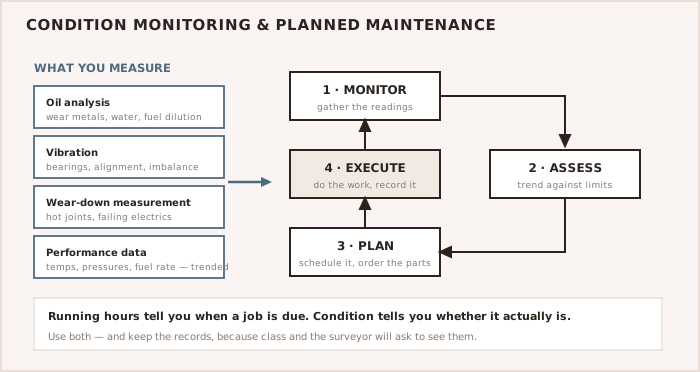
Condition monitoring means acting on measured deterioration rather than on the calendar. At this scale of plant, four techniques do most of the work:
- Lube oil analysis. A regular sample sent ashore tells you about wear metals, water ingress, fuel dilution, soot loading and additive depletion. It is the cheapest look inside a running engine you will ever buy.
- Vibration analysis. Bearing wear, imbalance, misalignment and looseness all have signatures, and they show up long before you can hear them.
- Thermography. A thermal camera finds hot bearings, failing electrical connections, blocked coolers and breakdown of insulation in minutes.
- Performance monitoring. Cylinder pressures, exhaust temperature spread, turbocharger speed, scavenge pressure, fuel rack position — tracked against load, over time.
TIP — The trend beats the number One oil sample tells you almost nothing. Four samples across a season tell you the engine is making iron at an increasing rate, and that is worth more than any single laboratory report. Sample at the same point, at the same temperature, at the same interval, and keep the history.
Turbochargers, and why they fail
Turbochargers fail from oil starvation, from fouling, and from ingesting debris. Watch the rundown time — a rotor that used to spin for a minute and now stops in twenty seconds is telling you about its bearings, for free. Watch the difference between air-in and air-out temperature and pressure. Clean on schedule, and find out why if you are cleaning early.
Alignment, shafting and the stern gland
The engine is only half of the propulsion train. Coupling alignment, bearing wear down the shaft, the intermediate bearings, the stern tube and its seal all deserve the same attention as the machinery you can hear. A vibration that appears at one particular RPM and nowhere else is a structural conversation, not an engine one.
CAUTION — The manufacturer's limits govern Every figure that actually matters — clearances, torques, temperature and pressure limits, overhaul intervals — comes from the engine builder's manual for your engine in your installation. This lesson teaches the shape of the discipline. It cannot give you the numbers, and any course that pretends to is guessing.