
Entry & progression
The generators do not count toward your propulsion power (46 CFR 10.107). They will, however, absolutely determine whether the ship is alive at three in the morning.
The architecture
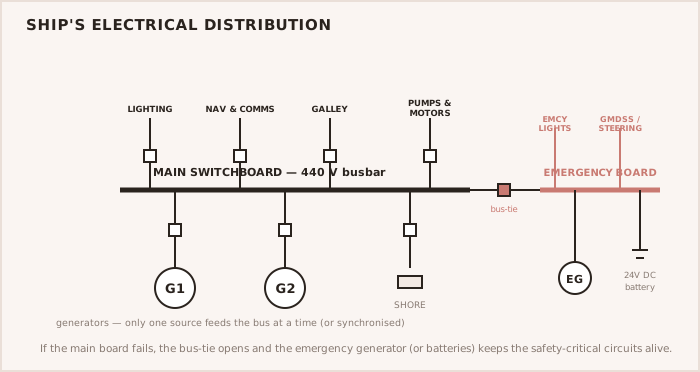
- Generators — prime mover plus alternator. The AVR controls voltage; the governor controls frequency.
- Main switchboard — where everything is connected, protected and distributed. The most dangerous object on the vessel.
- Distribution — feeders, sub-boards, transformers, breakers, essential and non-essential services.
- Emergency source of power — independent of the main plant, feeding the services that must not stop.
- Shore power — its own interlocks, its own earthing, its own expensive mistakes.
Paralleling
To put a second machine on the board you must match voltage, frequency and phase sequence, and close at the moment the incoming machine is in phase. Get it wrong and you will hear it: a bad synchronisation is a mechanical event as much as an electrical one, and it can wreck a coupling, trip the board, or both.
Then you have to share the load. Real power (kW) follows the governor. Reactive power (kVAR) follows the AVR. If one machine is carrying all the kW while the other idles, adjust the governors. If they are fighting over reactive load, that is excitation. Two controls, two jobs — do not confuse them.
Blackout
A blackout is rarely one failure. It is a chain: a fault trips one generator, the remaining machine is handed the whole load and trips on overload, and the board goes dead. Lights, steering, cooling and lube oil all go — and the main engines go with them.
Blackout recovery — the shape of it
- Confirm the emergency source has started and picked up its board. If it has not, that is now the first problem.
- Establish why the plant went down before you re-energise into the same fault.
- Shed the load. Trip or open non-essential feeders so the first machine back is not asked to carry the whole ship.
- Start and close in one generator. Confirm it is stable at voltage and frequency.
- Restore essential services deliberately and in order: steering, cooling, lube oil, control air, main engine auxiliaries.
- Restore propulsion. Keep reporting to the bridge — they are handling a ship without steerage while you work.
- Only then bring back hotel and non-essential loads.
- Log everything, including the times. This will be investigated.
WARNING — Know your recovery cold, in the dark, in the noise Blackout recovery is the one procedure you will execute under the worst conditions the vessel can produce: no light, no ventilation, alarms sounding, the bridge calling, and a ship that is drifting. Rehearse it. Write it down. Post it at the board. The time to learn the starting sequence is not while the ship is setting onto a lee shore.
Safety — this is where engineers die
- Isolate, lock, tag, test — and test your tester. Prove dead on the actual conductors, with an instrument you proved live immediately before and after.
- Assume every conductor is live until you personally proved it dead. Somebody else's isolation is not your isolation.
- Arc flash is not electrocution, and the PPE is not the same. A switchboard fault releases heat and pressure; a boiler suit is not an arc-flash suit.
- High voltage is a separate discipline with its own permits and training. If your vessel has an HV system and you have not been trained on it, you are not qualified to touch it.
CAUTION — Your STCW ticket can be restricted to what your ship does not have 46 CFR 11.323(b)(2) allows an STCW endorsement to be limited to vessels without auxiliary boilers, waste-heat boilers, distilling plants, oily water separators or sewage treatment plants. Many yachts lack some of these, so a yacht-trained engineer can end up holding a restricted STCW endorsement without realising it. The restriction is removable by demonstrating the competencies — but first you have to know it is there. Read the face of your endorsement.