
Entry & progression
Entry: L1.2. Progression: the formula in this lesson governs every rung above DDE — which is why you need to understand a rule you are exempt from. This is the lesson that explains why small-boat time hurts you later.
The formula — 46 CFR 11.503(b), verbatim
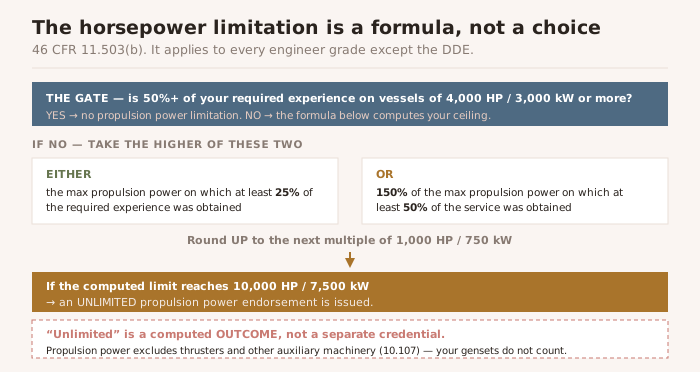
*"When an applicant for an original or raise of grade of an engineer endorsement, other than a DDE, has not obtained at least 50 percent of the required experience on vessels of 4,000 HP/3,000 kW or more, a propulsion power limitation is placed on the MMC based on the applicant's qualifying experience. The endorsement is limited to the maximum propulsion power on which at least 25 percent of the required experience was obtained, or 150 percent of the maximum propulsion power on which at least 50 percent of the service was obtained, whichever is higher. Limitations are in multiples of 1,000 HP/750 kW, using the next higher figure… When the limitation as calculated equals or exceeds 10,000 HP/7,500 kW, an unlimited propulsion power endorsement is issued."*
Read the fourth clause again: "other than a DDE." That carve-out is the whole lesson.
What the formula does to everybody else
On every other rung, "unlimited horsepower" is not a credential you apply for. It is an arithmetic outcome. You feed your service history into 11.503(b), it computes a number, and if that number reaches 10,000 HP / 7,500 kW the Coast Guard writes unlimited on your ticket. If it computes to 2,000 HP, that is your ticket, whatever grade is printed above it. It is the exact engineering twin of the deck tonnage formula at 11.422(a).
Why DDE is different
DDE tiers are earned by service quantity. One year, two years, three years — with a QMED portion inside each. That is it. You do not reach DDE 4,000 HP by serving on 4,000 HP boats; you reach it by serving 2 years with 1 year as a QMED, and the endorsement then authorises you up to 4,000 HP whether or not you have ever touched an engine that size. The tier is a measure of your time, not of your machinery.
NOTE — So the size of your boats doesn't matter? For the DDE, no. For everything above it, enormously. The moment you apply for Assistant Engineer-Limited, Chief Engineer-Limited or any unlimited grade, 11.503(b) starts running — and a career built entirely on small mains computes to a small limit. 11.503(c) gives the way out: 6 months in the highest grade endorsed on vessels of 4,000 HP / 3,000 kW or more removes all horsepower limits. If you intend to climb, get time on big machinery, and get it deliberately. See Lesson 4.3.
The unit pairs are regulatory, not arithmetic
10.107: "Kilowatt or kW means 1⅓ horsepower"; "One horsepower equals 0.75 kW." So 3,000 kW = 4,000 HP by regulation. Physically it is about 4,023 HP. Do not correct the CFR. Quote the pairs exactly as they are written: 1,000 HP / 750 kW, 4,000 HP / 3,000 kW, 10,000 HP / 7,500 kW. An application that argues with the definitions section is an application that gets returned.
And what counts as propulsion power
10.107, verbatim: "Propulsion power means the total maximum continuous-rated output power of the main propulsion machinery of a vessel determined by the manufacturer… which appears on the ship's Certificate of Registry or other official document and excludes thrusters and other auxiliary machinery."
Your gensets do not count. Your bow and stern thrusters do not count. Your hydraulic PTOs do not count. A yacht with an enormous electrical plant and modest mains can sit comfortably below a threshold that her engine room feels like she is over. The number is on the document.
One more axis: propulsion mode
11.502(a): "at least one-third of the minimum service requirements must have been obtained on the particular mode of propulsion for which the applicant seeks endorsement." Modes are steam, motor, gas turbine — or all modes (11.501(d)). To add one later (11.502(b)): 4 months as an observer, or 4 months as an operational-level engineer officer on the new mode, or 6 months as Oiler, Boiler Technician/Watertender or Junior Engineer on it, or an approved course.