
Entry & progression
This course is the practical layer under the whole USCG engineering pathway. It does not repeat the MMC application — TWIC, the medical certificate and the drug test are covered by the USCG MMC course in this library. Start here instead with the question that decides everything downstream: what, exactly, is a day?
The three definitions — 46 CFR 10.107
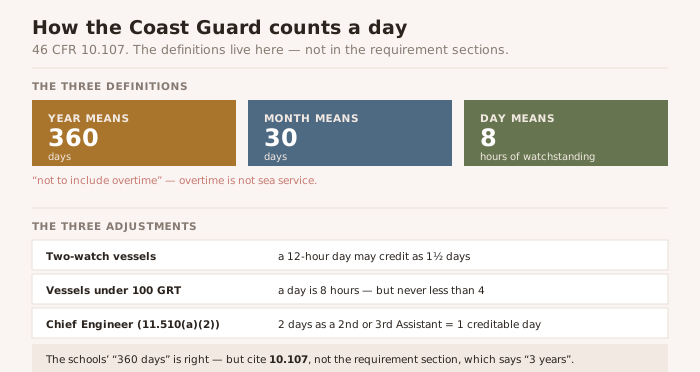
| Term | What 10.107 says it means |
|---|---|
| Year | 360 days, for the purpose of complying with the service requirements of the subchapter |
| Month | 30 days |
| Day | 8 hours of watchstanding or day-working, not to include overtime |
You will hear it said — confidently — that the CFR never says 360 days, that the schools invented it. That is wrong, and it is wrong in a way that costs people time. The requirement sections in Part 11 are written in months and years, so if you go looking for "360" in the section that describes your endorsement, you will not find it. It is in the definitions. Cite 10.107, not the requirement section, and the argument ends.
Overtime is not sea service
Read the definition of a day again. Eight hours of watchstanding or day-working, not to include overtime. A sixteen-hour day in a shipyard period is not two days. The hours beyond the working day do not accumulate into credit, however hard they were.
Two-watch vessels
There is one exception that runs the other way. On a two-watch vessel — where the watch system itself is built on twelve hours, not eight — a 12-hour day may be credited as 1½ days. That is a structural feature of how the vessel is manned, not a reward for working late. It is the difference between a watch system and an overtime sheet.
The four-hour floor on small vessels
On vessels of less than 100 GRT, a day is still eight hours — but 10.107 adds that "in no case will this period be less than 4 hours." Short days on a small boat are not automatically half-days. Four hours is the floor below which the day stops counting.
The only place the engineering ladder counts in days
Almost everything on the engineer side is measured in months and years. There is one conspicuous exception. 46 CFR 11.510(a)(2) — the Chief Engineer requirement — says that "2 days of service as a Second or Third Assistant Engineer equals 1 day of creditable service." That is the two-for-one rule, and it exists because the Coast Guard wants First Assistant time at the top of the ladder and will only half-credit anything below it.
NOTE — Why this lesson comes first Because the entire engineering pathway is denominated in this currency. When 46 CFR 11.522 asks for three years in the engineroom, it is asking for 1,080 days of eight qualifying hours — not three years on a payroll. Get the conversion wrong and every plan you build on top of it is wrong by the same margin.
CAUTION — The evaluator has the last word These definitions are the rule. How a specific set of discharges, letters and sea service forms is credited against them is a judgment made by an evaluator at the National Maritime Center, and practice can be tighter than you expect. Before you commit to a plan built on a particular reading of your own time, pull the current NMC checklist for the endorsement you want and ask the NMC.