
Entry & progression
The single most misunderstood rule in US small-craft licensing. Governing regulation: 46 CFR 11.422(a).
The rule, verbatim
46 CFR 11.422(a): the endorsement will be limited to the maximum GRT on which at least 25 percent of the required experience was obtained, or 150 percent of the maximum GRT on which at least 50 percent of the service was obtained, whichever is higher.
Read it twice. Two calculations, and you take the better answer. Both depend entirely on the tonnage of the vessels you served on — not on how long you served, not on where, not on how well.
What that means in practice
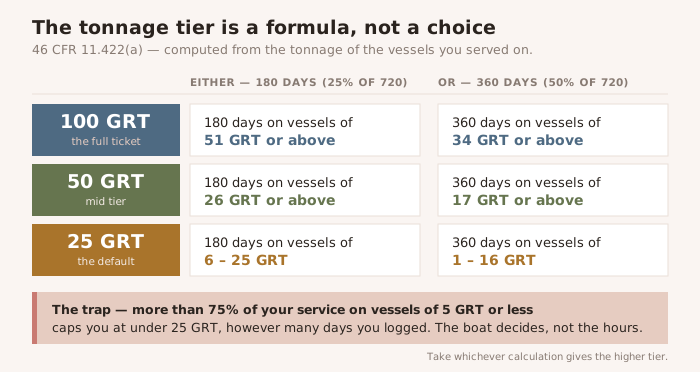
The NMC checklist does the arithmetic for you, against the 720 days of service required for the near-coastal route:
| Tier | Route A — 25% of service | Route B — 50% of service |
|---|---|---|
| 100 GRT | 180 days on vessels of 51 GRT or above | 360 days on vessels of 34 GRT or above |
| 50 GRT | 180 days on vessels of 26 GRT or above | 360 days on vessels of 17 GRT or above |
| 25 GRT | 180 days on vessels of 6–25 GRT | 360 days on vessels of 1–16 GRT |
Notice how little time it takes at the top. 180 days on a 51-ton boat gets you the full 100 GRT — a quarter of your service on a vessel of the right size does the whole job. That is the lever, and almost nobody pulls it deliberately.
The trap at the bottom
WARNING — More than 75 percent on vessels of 5 GRT or less caps you at 25 GRT 46 CFR 11.422(a) says so expressly. Build two full years of sea time on a small centre console and you will be issued a Master limited to vessels of less than 25 GRT — no matter how many days you logged, how far offshore you went, or how well you did it. The days are not wasted, but the tonnage is decided by the boat, and the boat was too small.
What this should change about how you build sea time
If you are working toward this credential, the tonnage of the vessels you serve on is not incidental — it is the single variable that decides what you end up holding. Two mariners can log identical years, identical routes and identical competence, and one walks out with 100 GRT and the other with 25.
- Find out the gross register tonnage of every vessel you serve on. Not her length. Not her displacement. Ask, and get it in writing.
- Record it on the CG-719S for that vessel — the form asks for gross tons precisely because the formula needs it.
- If you are short at the top, 180 days on a vessel of 51 GRT or more is the most efficient service you can possibly get. Chase it deliberately.
- If most of your time is on very small craft, understand before you apply that you are heading for a 25 GRT limitation, and plan the fix rather than discover it.
This is the lesson that pays for the course. Everything else here you could learn on the water. This you can only learn from the regulation — and by the time it bites, it is years too late to change.