
Entry & progression
Exam module: Q160 — Deck General. 50 questions, 70% pass mark. The single most important technical subject on this credential.
The three points
| Point | What it is | What moves it |
|---|---|---|
| G — centre of gravity | Where the vessel's weight acts, downward | Every weight you add, remove or shift. Passengers, fuel, water, gear |
| B — centre of buoyancy | The centre of the underwater volume, acting upward | Moves as the hull heels and the underwater shape changes |
| M — metacentre | The point about which the vessel effectively pivots at small angles | Fixed by the hull form for a given draught |
GM — the number that decides everything
GM is the distance from G to M, and it is the measure of initial stability. Positive GM means that when the vessel heels, buoyancy shifts outboard and creates a righting moment that pushes her back upright.
- Large GM — stiff. She resists heeling hard and snaps back quickly. Uncomfortable, and hard on the rig and the crew, but safe.
- Small GM — tender. She heels easily and returns slowly, with a long lazy roll.
- GM zero or negative — she has no righting moment, or a capsizing one. She will loll to one side and stay there, and she may go over.
WARNING — Every kilo you add high up raises G and reduces GM A new radar on the mast, a dinghy on the coachroof, twenty passengers who all stood up on the flybridge — each one raises the centre of gravity and eats your reserve. Weight low is stability. Weight high is the thing that kills small passenger vessels, and it almost never announces itself.
Free surface effect
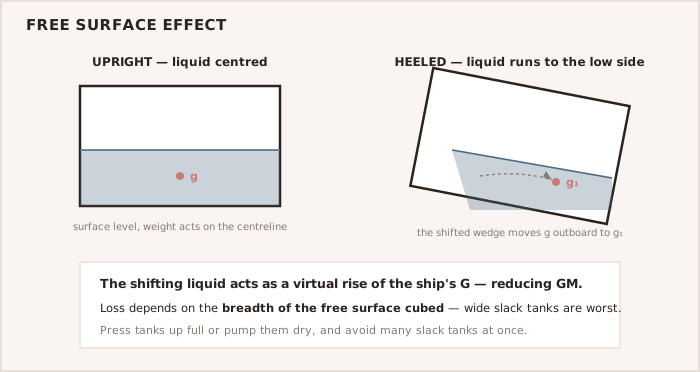
This is the one that catches people, because it costs you stability without adding any weight at all.
Liquid in a partly filled tank runs to the low side as the vessel heels, moving its weight outboard and adding to the heel. The effect is the same as raising G. A half-full tank is far worse than a full one — and a bilge with a foot of water sloshing across the whole beam of the vessel is worse than either.
- Free surface loss depends on the width of the free surface, cubed. Halve the width and you cut the effect to an eighth.
- That is exactly why tanks have baffles — they divide one wide free surface into several narrow ones.
- Press tanks full or run them empty. Slack tanks are the enemy.
- Keep the bilges dry. Water in the bilge is not just weight; it is free surface across the widest part of the boat, and it is why a flooding vessel can capsize long before she would have sunk.
The passenger problem
Passengers are a moveable weight that talks. Twenty people on a 60-foot boat is roughly a tonne and a half, and it walks to whichever rail has something to look at.
Crowding is a stability calculation, not a nuisance. When everyone moves to one side, G moves with them — and on a vessel already heeled by wind or a turn, that is the moment the reserve disappears. Move them back. Say it out loud, early, and do not be shy about it; every master who has lost a boat this way was too polite for about fifteen seconds.