
Entry & progression
Exam module: Q171. Feeds: the chart plot module (Q172) directly.
Three norths
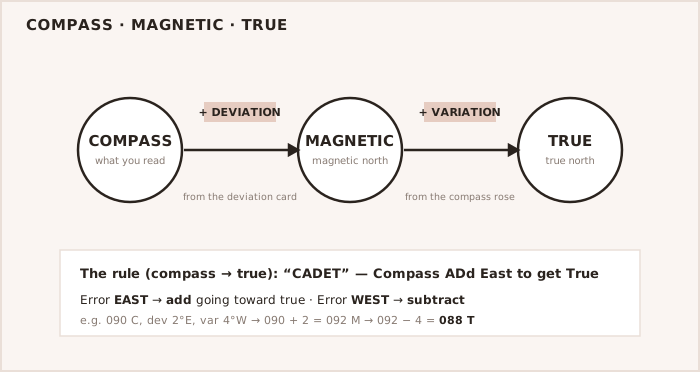
- True north — the geographic pole. What the chart's meridians point to.
- Magnetic north — where the earth's magnetic field points. Differs from true by variation.
- Compass north — where your compass points, in your boat. Differs from magnetic by deviation.
Variation
A property of place, not of the boat. Printed inside the compass rose on the chart, with the year it was measured and an annual rate of change. It is the same for every vessel in that area and it changes slowly with time.
Deviation
A property of the boat, not the place. Caused by the iron and electrical fields in the vessel herself, and it changes with the vessel's heading — which is why a deviation card lists an error for each heading rather than one figure. Move a speaker next to the binnacle and you have changed it.
TIP — Deviation follows the boat; variation follows the chart If the question changes location, variation changes. If the question changes heading, deviation changes. That one sentence answers a surprising number of exam questions without any arithmetic at all.
Working between them
The classic sequence, outbound from compass to true:
- Compass
- Deviation
- Magnetic
- Variation
- True
Can Dead Men Vote Twice — and going that way (compass to true), you add easterly errors. Reverse the sequence (True, Variation, Magnetic, Deviation, Compass — True Virgins Make Dull Companions) and you add westerly errors instead. The direction you are working decides the sign, which is why candidates who memorise "east is least" without asking least of what get half of them backwards.
| Working | Easterly error | Westerly error |
|---|---|---|
| Compass → True | Add | Subtract |
| True → Compass | Subtract | Add |
Compass error
Variation and deviation combined, expressed as a single figure east or west. Where both are the same name, add them. Where they are opposite names, subtract the smaller from the larger and take the name of the larger.
You check compass error at sea by comparing the compass bearing of a known object — a transit, a celestial body, a charted range — with its true bearing. The difference is your total error, and a compass whose error you have not checked recently is a compass you are trusting on faith.
Bearings
- True bearing — measured clockwise from true north, 000° to 359°.
- Magnetic bearing — measured from magnetic north.
- Relative bearing — measured clockwise from the vessel's head, not from north. A relative bearing of 090° is on the starboard beam whatever course you are steering.
To convert a relative bearing to a true bearing, add the vessel's true heading. If the result exceeds 360, subtract 360. A target bearing 045° relative, on a heading of 330° true, bears 375 — which is 015° true. The exam asks this, and it asks it in the direction that requires you to notice the wrap.
WARNING — A compass does not know it is wrong Deviation changes when the boat changes — a new radio, a chart plotter, a toolbox left in the wrong locker, a can of beans. The deviation card on the bulkhead was accurate on the day it was made. Swing the compass after any significant electrical or structural work, and check the error against a transit whenever the opportunity presents itself. Nothing about a compass tells you it has started lying.