
Entry & progression
A day is eight hours. A month is thirty days. A year is 360 days. Those are not school rules of thumb — they are definitions in 46 CFR 10.107, and everything you will ever claim is built out of them.
The three definitions, verbatim
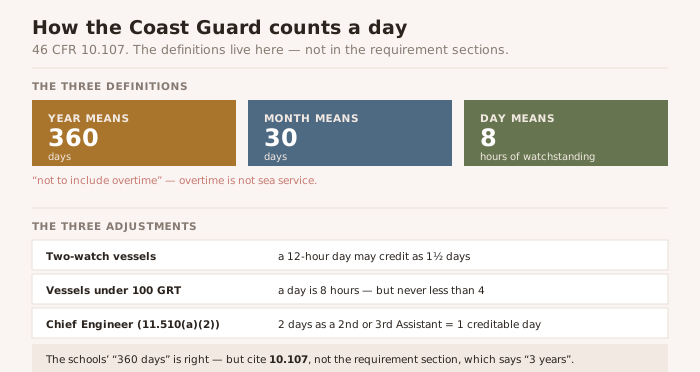
| Term | 46 CFR 10.107 says |
|---|---|
| Year | "360 days for the purpose of complying with the service requirements of this subchapter" |
| Month | "30 days" |
| Day | "8 hours of watchstanding or day-working not to include overtime" |
Three things fall out of that immediately. A twelve-month contract is not a year of sea service unless you worked 360 creditable days in it. Overtime buys you nothing. And the unit the Coast Guard actually credits is the day worked, not the day on the crew list.
The two-watch exception
On a vessel operating a two-watch system, a twelve-hour day may be credited as one and a half days. That is the regulation rewarding the fact that you genuinely stood a longer watch — not a licence to inflate. It applies to the watch system the vessel actually ran, and the sea service letter has to say so.
The floor on small vessels
On vessels of under 100 GRT, a day is still eight hours, but the regulation adds a floor: "in no case will this period be less than 4 hours." Below four hours underway, the day does not exist. On a small yacht doing short hops this matters more than anybody expects.
WARNING — Days aboard are not days worked Being on the yacht is not the same as working the yacht. Shipyard periods, standby, leave and a boat sitting on the dock are not automatically creditable days. Count what you actually stood or worked, be able to show it, and let the NMC be pleasantly surprised rather than suspicious.
Recency — the trap at the far end
46 CFR 11.201(c)(1): an applicant must have "at least 3 months of required service… within the 3 years immediately preceding the date of application." (Seven years for uniformed-services vessels.)
This is where careers stall. Sea time does not rot — a year you did in 2019 is still a year — but if none of your service falls inside the last three years, you cannot apply at all until you go back to sea and put three fresh months on the board. Do not sit ashore on a full sea service portfolio and let the clock run out.
Keep the record yourself
The sea service discipline that survives a career
- Keep a personal log of dates on and off every vessel, from day one.
- Record the vessel's tonnage and its propulsion power — engineering is credited on power.
- Record the route run and the watch system worked.
- Get the discharge letter signed when you leave, not years later.
- Photograph or scan everything. Paper goes missing; boats change hands.
The mariners who reach the top of this ladder are not the ones who worked hardest. They are the ones who can prove what they worked.