
Entry & progression
Governing: 46 CFR Part 10, Subpart C — §§ 10.301 to 10.306. Cost: nothing.
The form and who may sign it
CG-719K (or CG-719K/E for entry-level ratings). 46 CFR 10.302(b): the examination must be performed, witnessed or reviewed by a licensed medical doctor, physician assistant, nurse practitioner, or a Designated Medical Examiner, holding a valid US licence. Your own doctor will usually do.
The Coast Guard retains final authority on whether you are fit. The examiner reports; the NMC decides.
Vision — the deck standard
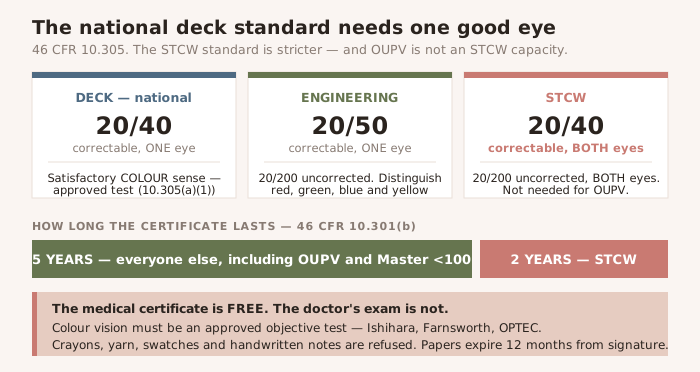
| Deck (10.305(a)) | Engineering (10.305(b)) | |
|---|---|---|
| Correctable to | 20/40 in one eye | 20/50 in one eye |
| Uncorrected, same eye | at least 20/200 | at least 20/200 |
| Colour | Satisfactory colour sense, by an approved test | Must distinguish red, green, blue and yellow |
Note that the national deck standard needs only one good eye. The STCW standard (10.305(a)(2)) requires 20/40 correctable in both. If you never intend to hold an STCW endorsement, the one-eye standard is the one that applies to you.
NOTE — The colour vision test must be objective The NMC will not accept 'the crayon test', a yarn test, coloured swatches, a tick-box or a handwritten note. It wants a named, approved test — Pseudoisochromatic Plates (Ishihara, Dvorine, AOC-HRR), Farnsworth Lantern, Titmus/OPTEC 2000, Optec 900, or the Richmond Test. Applications are returned over this more often than over the eyesight itself.
Hearing
46 CFR 10.306. The audiogram is not automatic. It is triggered only if the examining practitioner has concerns that hearing may affect maritime safety. If referred, the standard is:
- An unaided threshold of 30 decibels or less in at least one ear, tested at 500, 1,000, 2,000 and 3,000 Hz.
- Functional speech discrimination at 65 dB of at least 90 percent for an original, and 80 percent for a renewal or raise of grade.
The physical demonstration
46 CFR 10.304(c)(2) lists nine criteria, and they are practical rather than clinical — can you actually do the job:
- No disturbance of balance. Climb vertical ladders and inclined stairs unassisted.
- Step over a coaming. Move through a restricted opening of 24 by 24 inches.
- Grasp, lift and manipulate tools and valve wheels. Stand and walk for extended periods.
- Respond to visual and audible alarms. Hold a normal conversation.
The two expiry dates that matter
| How long | |
|---|---|
| The exam paperwork | Must be submitted within 12 months of being signed. Once part of an accepted application, it stays valid 12 months from acceptance (10.304(d)) |
| The certificate itself — STCW mariners | 2 years (1 year if under 18) |
| The certificate itself — everyone else | 5 years (10.301(b)(2)) |
OUPV and Master under 100 GRT are not STCW capacities, so the 5-year certificate is the one you will hold. There is no fee for a medical certificate, and no CG-719B is needed to apply for one on its own.
Waivers
46 CFR 10.303: the Coast Guard may grant a waiver where the standard is not met but objective medical evidence shows the condition is sufficiently controlled and poses no significant risk. Waivers commonly carry conditions, operational limitations, or a shortened certificate — often 1 or 2 years. Carry the waiver letter when you sail.