
Entry & progression
The examination stopped at First Assistant. The responsibility does not. Chief Engineer is the only grade on this ladder you reach without being tested — because the test is the job.
The regulatory definition of the management level is the place to start, because it is precise and people misread it. 46 CFR 10.107 — management level means "ensuring that all functions within the designated area of responsibility are properly performed." Compare the operational level: "maintaining direct control over the performance of all functions… under the direction of an individual serving in the management level."
Ensuring is not doing. The chief who is inside the engine with a spanner because nobody else can be trusted with it has not solved a problem — they have described one. The department is the deliverable.
The relationship with the master
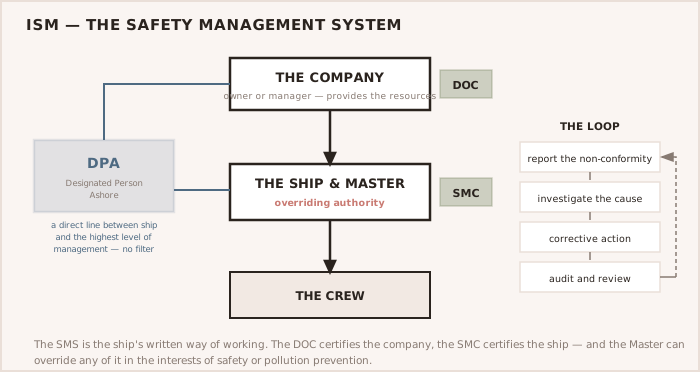
The master commands the vessel. That is not in dispute and a chief engineer who disputes it is a problem. But the chief owns the condition of the machinery, and there is exactly one thing the chief must be able to say to the master without hedging: "the plant will not do that."
- Say it early, before the commitment is made, not at the pilot station.
- Say it in terms of consequence, not preference — "we can hold that speed for six hours, then I will have to reduce for a bearing temperature" is a decision the master can work with. "I'd rather not" is not.
- Write it down. A verbal reservation that was overruled and never recorded did not happen.
- And when the answer is no, it is no — and the SMS exists to back you.
ISM, the SMS and the designated person ashore
Every commercially operated vessel of consequence runs under a safety management system. The shape of it is consistent enough to state plainly: written procedures for shipboard operations; defined responsibility and authority for each role; a reporting route for non-conformities, accidents and hazardous occurrences; planned maintenance with records; drills; internal audit; and management review.
Two features of it matter enormously to a chief engineer. The first is that the master's overriding authority to take any decision necessary for safety is written into it. The second is the designated person ashore — a named individual with direct access to the highest level of management, whose existence is the answer to "the office is leaning on us and the vessel is not safe."
WARNING — The DPA is a route you are entitled to use, and using it is not disloyalty The DPA exists because commercial pressure on a vessel is a known and predictable failure mode, and somebody ashore has to be reachable outside the chain that is applying the pressure.
A chief engineer who raises a machinery defect to the DPA is doing their job as designed. A chief engineer who does not, and sails, owns the outcome personally. Report the defect. In writing. Keep the copy.
CAUTION — The ISM Code itself is outside this fact base The ISM Code, its applicability to a given vessel, the Document of Compliance, the Safety Management Certificate, audit intervals and the flag-state machinery around them are real and binding but are not in the source used to build this course, and no clause numbers are cited here on purpose.
Get the applicability and the detail from your flag administration, your class society and the vessel's own SMS. Whether and how ISM applies to a particular yacht is a question for the flag, not for a training page.
The department
- Watch and rest hours. A fatigued engineer is a hazard you introduced. Manage the rota before it breaks.
- Handover. In writing, on the plant, with the defect list and the current overrides. Lesson 3.4.
- Training and assessment. Your crew's endorsements have your service letters behind them — and from 1 January 2029 STCW assessments must be signed by a Qualified Assessor approved by the Coast Guard (46 CFR 10.405). Assessments signed before that date are accepted until 30 June 2029. Any belief that "any chief can sign an assessment" has a hard expiry date.
- Records. Oil record book, maintenance records, hours, tests. Honest, contemporaneous, legible. They are the only evidence you will have when someone asks what you knew and when.