
Entry & progression
Read this before assuming anything transfers. Almost nothing else does.
The differences that matter
| MCA | USCG | |
|---|---|---|
| The credential | Certificate of Competency (CoC) | Merchant Mariner Credential (MMC) — one book, many endorsements |
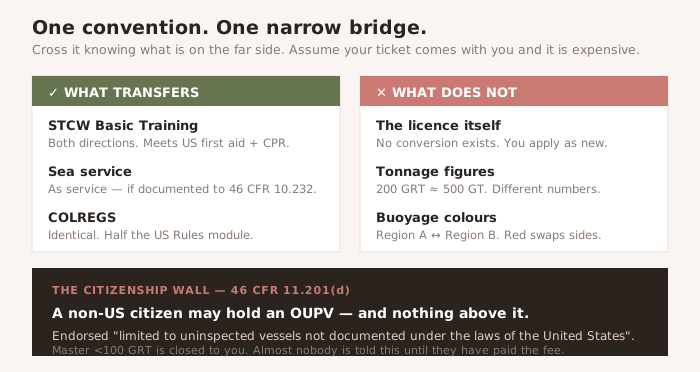
| Tonnage measure | Gross tonnage (GT), ITC 69 | Gross register tons (GRT) for national endorsements — an older, different measure |
| Entry ticket | RYA Yachtmaster, then MCA CoC | OUPV — the six-pack |
| Medical | ENG1 | Medical certificate on CG-719K — and it is free |
| Security card | None equivalent | TWIC (with the PL 11-15 exemption for UPVs) |
| Drug testing | Not a condition of the CoC | Mandatory — a negative test is a condition of issue |
| Rules of the road | COLREGS | COLREGS and the Inland Rules — two rulebooks, and a demarcation line |
| Oral exam | Central to the MCA ladder | None. The US system is written, multiple choice |
WARNING — GRT is not GT, and the difference is not academic The US national endorsements are measured in gross register tons — an older volumetric measure — while the modern international standard is gross tonnage under ITC 69. They are different numbers for the same boat. 46 CFR 10.232(i) gives the working equivalence: 200 GRT ≈ 500 GT, and 1,600 GRT ≈ 3,000 GT. A yacht you think of as "a 500-tonner" is, in the US national system, a 200 GRT vessel. Never assume the number transfers.
The oral exam, and its absence
This is the largest cultural difference between the two systems, and the one that surprises MCA-trained crew most.
The MCA ladder is built around the oral examination — a senior examiner, a table, and an hour of being asked what you would do. It tests judgement, and it is famously hard to fake.
The US system has no oral exam at these levels. It is a written, multiple-choice examination with published question banks and hard pass marks — 70 percent for most modules, and 90 percent for Rules of the Road, with no references permitted. It tests recall and precision rather than judgement.
Neither is better. But they reward completely different preparation, and an MCA candidate who prepares for a US exam the way they would prepare for an oral will fail it — not on seamanship, but on the fifty small precise facts the paper actually asks about.
What you will find familiar
- COLREGS — identical. Your Rule 13, Rule 15 and Rule 34 knowledge transfers directly to the International half of the US exam.
- Buoyage — the system is IALA, so the grammar is familiar. But the US is Region B: red to starboard returning from seaward. The colours are reversed from Region A. This catches every single MCA-trained mariner at least once.
- Navigation, chartwork, tides, stability — the seamanship is the seamanship. It does not change with the flag.
CAUTION — Region B: the buoyage colours are reversed If you learned your buoyage in Europe, you learned Region A — red to port entering harbour. In the United States it is red to starboard. Same shapes, same numbering, opposite colours. It is the most dangerous piece of muscle memory you will carry across the Atlantic, and it is worth saying out loud on your first US approach.