
Entry & progression
The Electro-technical Officer is a branch, not a rung. It is not above Engineer Class 1 and it is not below it. It is the certificate you take when the electrical plant is the job — and on a modern yacht, it usually is.
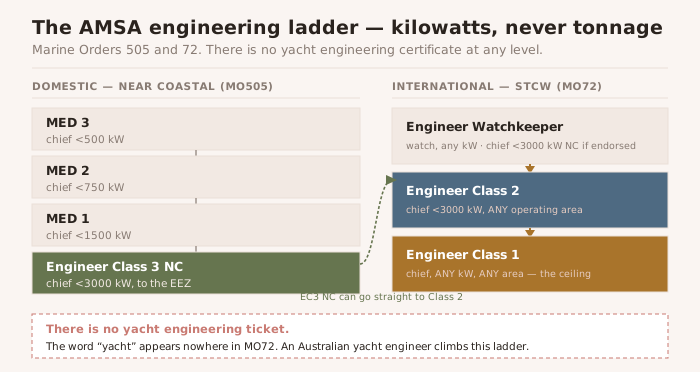
Start by killing the misconception, because it is everywhere. The ETO is not the level above Engineer Class 1. AMSA's own Engineer Class 1 page notes that with additional sea service and study an EC1 holder can go on to qualify for an ETO certificate. That is not a promotion. Nothing sits above Engineer Class 1. An EC1 moving to an ETO is stepping sideways into a different discipline, not upward into a higher one.
Say it plainly: the ETO is a lateral move. Anyone selling it to you as the top of the engineering ladder has not read the instrument.
The entitlement
| Duty | Scope |
|---|---|
| Electro-technical officer | A vessel of any propulsion power, in any operating area |
| Able seafarer — engine | Rating duties in the engine department |
Note what is missing from that table. There is no kilowatt ceiling on the propulsion plant and there is no operating-area limit. An ETO certificate does not care whether the main engines make 900 kW or 9,000 kW, and it does not care whether the vessel is in the Whitsundays or the Southern Ocean. That is unusually clean for an AMSA certificate — the engineer certificates are all scoped in kilowatts and all specify a kind of propulsion. The ETO is not.
But read it just as carefully for what it does say. It entitles you to perform ETO duties. It does not make you the chief engineer. It does not make you a watchkeeper. The engineer certificates and the ETO certificate cover different functions, and the ETO is the electro-technical one.
The domestic equivalence
NOTE — An ETO can work as a MED 2 near coastal This is a real and useful piece of crosswalk. In the domestic system, an Electro-technical officer can perform the duties of a Marine Engine Driver Grade 2 near coastal — chief engineer on an inboard vessel under 750 kW, second engineer under 1500 kW, engine room of a vessel under 3000 kW, near coastal.
So an ETO who comes home to the Australian coast is not standing there with nothing. The international electro-technical ticket carries a domestic engine-driver entitlement with it.
Where it actually earns
The honest reason to build this certificate is not the ladder. It is the boat. A modern superyacht is a floating power station: air conditioning for every space, audiovisual systems in every cabin, stabilisers, bow and stern thrusters, hydraulics, galley loads, laundry, and on newer hulls a hybrid or diesel-electric drive. The electrical plant on these vessels routinely outruns anything on a merchant ship of comparable size.
That is not a marketing line. It is the reason the ETO qualifies as a yacht certificate when no other AMSA engineering ticket does — as you will see in Lesson 1.3, the sea-service threshold for the ETO is measured on electrical generation capacity, not on propulsion power. Yachts clear it.
There is no AMSA yacht engineering certificate. The word 'yacht' does not appear anywhere in Marine Order 72. But the ETO is the certificate whose requirements were written in a unit that yachts happen to be very good at producing.