
Entry & progression
The ETO owns the generation plant. Everything downstream of the busbar is somebody's convenience. Everything upstream of it is the vessel's ability to stay alive.
A vessel makes its own electricity, and it makes it in a plant with no grid behind it. Ashore, if a generator drops off, the grid absorbs it and nobody notices. At sea there is no grid. The load that machine was carrying has to go somewhere in the next few hundred milliseconds, and if the remaining sets cannot take it, they trip too. That cascade is a blackout, and it is the event the whole design exists to prevent.
Paralleling — three conditions, no exceptions
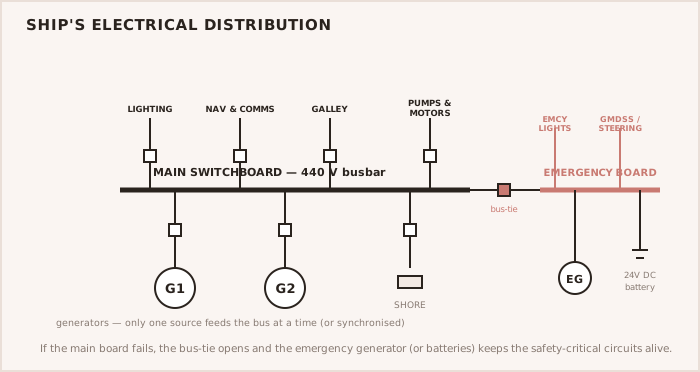
To bring an incoming alternator onto a live bus, three things must match the bus at the moment the breaker closes.
- Voltage — the incoming machine's terminal voltage matched to the bus
- Frequency — matched, and ideally a fraction high, so the machine walks onto load rather than motoring
- Phase angle — the waveforms aligned at the instant of closing, and the phase rotation the same
Close a breaker out of phase and the machine will try to snap into step with the bus instantly. The torque that produces goes through the coupling, the shaft and the foundations. Synchroscopes, check-synchronising relays and auto-synchronisers exist because human judgement at that instant is not good enough.
WARNING — Never defeat a check-sync relay to get a machine on the bus It is the last thing standing between an impatient closing and a wrecked alternator. If the synchroniser will not let you close, the reason is that closing would be wrong. Find the reason. The temptation to override arrives at exactly the moment you can least afford to be wrong — a falling bus, a guest evening, a chief on the phone.
Load sharing
Once two machines are in parallel, they must share. Real power (kW) is shared by governor characteristic — the droop or isochronous setting of each engine's speed control. Reactive power (kVAr) is shared by excitation — the AVR characteristic of each alternator.
| Symptom | Where to look |
|---|---|
| Machines split unequally on kW | Governor droop / speed setpoint / load-sharing line |
| Machines split unequally on kVAr | AVR voltage setpoint / excitation droop / cross-current compensation |
| One machine motoring (reverse power) | Governor setpoint too low, or fuel starvation on that engine |
| Hunting between machines | Governor gains, or two isochronous machines fighting without a load-share line |
A machine drifting toward reverse power is not sharing badly — it is being driven by the bus, and the reverse-power relay will remove it. Watch the kW split, not just the amps.
Blackout recovery
The order of a blackout recovery
- Emergency source picks up its own board automatically — confirm it did, and confirm what it is feeding.
- Restart a generator. Air or batteries: know which, and know the state of both before you need them.
- Establish the bus dead and close the first machine onto a dead bus — no synchronising required.
- Restore essential services in order: steering, then propulsion auxiliaries, then the rest.
- Restore the hotel load LAST, and restore it in blocks. Throwing the whole ship back on at once is how you black out a second time.
The sequence above is not a rule of thumb. Every vessel has its own blackout recovery procedure, written to its own plant, and it is one of the very few documents you should be able to recite in the dark. Because that is when you will need it.