
Entry & progression
This is the lesson that keeps you alive. Everything else in this course is a career. This is a life. Read it as if the switchboard has already killed someone, because somewhere it has.
Marine practice draws the line at 1000 V: below it is low voltage, above it is high voltage. The number people fixate on is the shock. The number that actually kills at high voltage is the energy — the fault current a marine switchboard can deliver into an arc is enormous, and an arc flash does not need to touch you. It radiates. It is over before your reflexes have started.
Large yachts are no longer immune to this. Vessels running diesel-electric or hybrid propulsion, or carrying heavy thruster and stabiliser loads, are built with medium- and high-voltage distribution — 690 V systems are common, and above that the discipline changes completely. Do not assume a yacht is a low-voltage boat because it is a yacht.
The permit to work
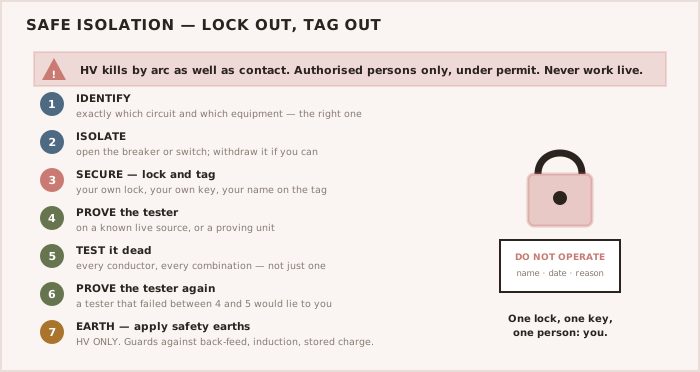
High voltage work is done under a permit to work, and the permit is not administration. It is the mechanism by which one named person — the authorised person — takes responsibility for the state of the system, and by which nobody can restore it while you are inside it.
Isolation, in order, every time
- Identify the exact equipment and the exact points of isolation. Not the ones on the drawing — the ones on the deck.
- Isolate — open the breaker, rack it out, open the isolator. Remove the means of reconnection.
- Secure — lock off and tag. Your lock. Your key. In your pocket, not in the drawer.
- Prove the tester on a known live source or a proving unit.
- Test for dead at the point of work, all phases, phase-to-phase and phase-to-earth.
- Prove the tester again on the known source. If it failed between the two proves, your dead test meant nothing.
- Earth — apply earths / earthing switches, so that if the system is re-energised it faults to earth instead of through you.
- Then the permit is issued, and only then does work begin.
WARNING — Prove — test — prove. Never two steps out of three. A voltage tester that has failed silently reads dead on everything, including a live busbar. The only way to know your tester was working at the moment you tested is to prove it working immediately before and immediately after.
People die from this exact omission. Not from carelessness — from a tester that was fine yesterday.
Capacitance, and the thing that is still live after isolation
Isolation removes the source. It does not necessarily remove the charge. Cables have capacitance; so do power-factor correction banks, drive DC links and filter circuits. A long HV cable run can hold a lethal charge after the breaker is open, and a DC link in a large drive can hold one for minutes.
That is why you earth. The earth is not a formality applied to a system you already know is dead — the earth is what makes it stay dead, and what discharges what isolation left behind.
Insulation and earth faults
Marine distribution is commonly an insulated (IT) system: a single earth fault does not trip anything, it simply lights a lamp. That is deliberate — a ship should not lose steering because one cable chafed. But it means the vessel can run for weeks with one earth fault standing, and the day a second fault appears on another phase, you have a phase-to-phase fault through the hull.
So an earth fault alarm is not information. It is a job. Find it, and find it while it is still the only one.