
Entry & progression
The safety management system is not paperwork you do after the job. It is the structure that lets you report a defect you know will be unpopular - and survive doing it.
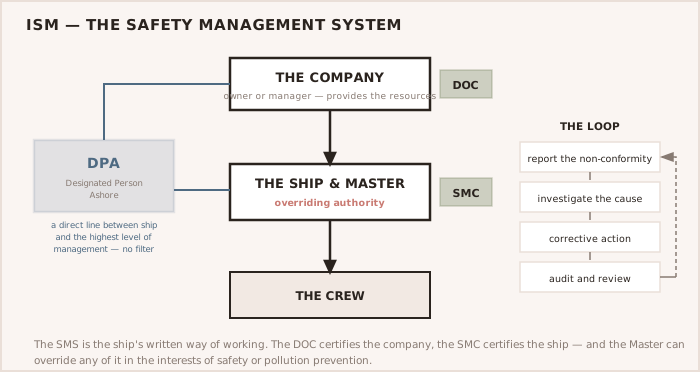
The International Safety Management Code requires a company operating a vessel to run a documented safety management system - an SMS - and to be audited against it. The company holds a Document of Compliance; the vessel holds a Safety Management Certificate. The SMS is where the vessel's procedures, responsibilities, maintenance regime, emergency plans and reporting routes actually live.
CAUTION — Whether ISM applies to your vessel is a flag question Application of the ISM Code depends on the vessel's flag, size and how she is used. Do not assume from this lesson that it does or does not apply to a particular yacht. Confirm with the flag administration, the company and - for Australian-regulated vessels - with AMSA.
What the SMS asks of the chief
- Maintenance of the ship and equipment - a planned maintenance system, run to intervals, with records that show the work was actually done.
- Critical equipment - the items whose sudden operational failure could cause a hazardous situation must be identified, and given measures to promote their reliability, including regular testing of standby arrangements.
- Reporting of non-conformities, accidents and hazardous occurrences - including near-misses, which are the cheapest lessons available to any department.
- Emergency preparedness - drills, and the procedures they exercise.
- Master's review and internal audit - the SMS is supposed to change when it is found wanting.
The designated person ashore
The DPA is the link between the vessel and the highest level of management ashore, with direct access to that level. That access does not pass through the master, the fleet manager or the owner's representative. It exists precisely for the situation where the normal chain of command is the problem.
Use it properly. The DPA is not a first resort for a disagreement about a spare part, and a chief who escalates everything ashore will be ignored when it counts. But when you have raised a genuine safety issue, put it in writing, and been told to drop it - that is what the DPA is for, and you should not hesitate.
The unpopular defect
Reporting a defect nobody wants to hear about
- Establish the facts. Parameters, readings, photographs, the maker's limits. Not impressions.
- Make it safe now. Isolate, reduce load, change over to standby, restrict operation - whatever reduces the immediate risk.
- Tell the master. Immediately, verbally, and then in writing: what has failed, the consequence, your recommendation, the time and the cost.
- Raise it in the SMS. A defect report or a non-conformity. If it is not in the system it did not happen, and you have no protection.
- Notify the company through the reporting route the SMS actually specifies.
- If a statutory certificate or a condition of class is affected, class and flag must be informed. Confirm the route - do not improvise it.
- If you are told to bury it, go to the DPA. In writing.
WARNING — The season is not a reason The pressure on a yacht engineer to defer a defect until the guests are off is real, and it is the single most reliable predictor of a casualty at the worst possible moment. Defer work on the basis of a documented risk assessment, or do not defer it at all.