
Entry & progression
The switchboard does not need you to touch it to kill you. High-voltage work is the one area where a management-level engineer's job is mostly about stopping people - including himself - from doing something reasonable-looking and fatal.
The permit to work
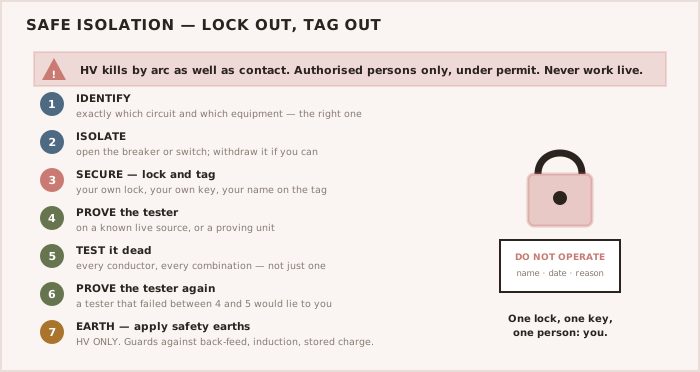
No HV work happens without a permit. The permit exists so that one identified person authorises the work, one identified person carries it out, the isolation is written down rather than remembered, and the system cannot be re-energised while anyone is still inside it. It is bureaucracy for exactly the reason bureaucracy exists: memory fails, and people are helpful.
Isolating a high-voltage circuit
- Identify the circuit - positively, at the equipment and at the switchboard. Labels lie; verify.
- Isolate it. Open the breaker, rack it out to the isolated position, and open any upstream disconnector.
- Lock off and tag. The person working on the circuit holds the key. Not the ETO, not the chief - the person inside the panel.
- Prove dead: test, prove, test. Prove the tester on a known live source, test the circuit, then prove the tester again. A tester that failed silently between steps has killed people.
- Discharge and earth. Cable capacitance and drive DC-link capacitors store lethal energy after isolation. Apply earths and leave them on.
- Only then, work. Restore in reverse order, earths off last but one, permit cancelled last.
WARNING — Stored energy kills after the breaker is open Long HV cable runs behave as capacitors. Variable-frequency drives hold charge in the DC link long after the supply is removed. "The breaker is open" is not "it is safe". Discharge, earth, and wait the manufacturer's stated time.
Arc flash
An arc flash is not electrocution. It is an explosion: a short circuit vaporising copper, producing a pressure wave, molten metal, and a light and heat pulse capable of fatal burns at a distance from equipment nobody has touched. Racking a breaker in or out is one of the higher-risk operations aboard. The defences are: work de-energised as the default; keep the doors shut; use remote racking if it is fitted; wear arc-rated clothing; and keep people out of the arc flash boundary who have no reason to be there.
Earth faults on an insulated system
Marine distribution is commonly run with an insulated neutral, precisely so that a single earth fault does not trip the system - a vital property in a ship, where you would rather have a fault than a blackout. The insulation monitoring device tells you an earth fault exists somewhere. Find it. The system is now one fault away from a phase-to-phase short through the hull, and the second fault is the one that takes the switchboard with it.
CAUTION — Electrical rescue: you cannot help by joining the casualty Do not touch a person in contact with an HV conductor. Isolate first, prove dead, earth, and only then approach. This is one of the very few emergencies where the correct first action is to do nothing to the casualty at all.