
Entry & progression
Two fluids run the plant, and both of them are ruined by the same enemy: water. Most of an engineer's real maintenance life is spent keeping fuel and lube oil clean, cool and moving.
The fuel system, tank to injector
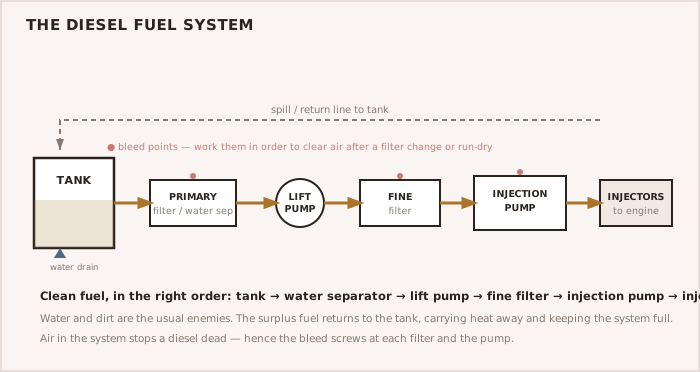
Storage tank, transfer pump, settling or day tank, primary filter and water separator, fine filter, fuel supply pump, injection pump, injector — with a return line taking surplus fuel back to the tank. Every element in that chain is either a place where fuel sits and separates, or a place where dirt is taken out of it. Understand it as a cleaning process that happens to end in combustion.
Water and bugs
Water gets into fuel by condensation on cold tank walls, by bad bunkers, and by leaks. It settles at the bottom of the tank, and at the interface between water and diesel a microbial colony grows — the black, stringy sludge that blocks filters and corrodes tank plate from the inside. It is called diesel bug and it is the single most preventable cause of engine failure in the industry.
- Keep tanks full. Less air space, less condensation.
- Drain water from the settling tank and the separator bowl as routine, not as a fault-finding step.
- Sample your bunkers. Take a drawn sample every time you take fuel, and keep it.
- Watch the filter differential. A rising pressure drop across the primary filter is your early warning.
- Polish and treat where the vessel's system provides for it, in accordance with the maker's guidance.
WARNING — The bug bites when the boat starts moving A vessel that has sat quietly on a berth grows a comfortable layer of sludge at the bottom of the tank. The first serious sea state stirs it into suspension, it goes straight to the filters, and the engine stops — in weather, off a lee shore, at the worst moment available. This failure is not random. It is scheduled, and the schedule is written by whoever did not drain the tanks.
The lube oil system
Sump, suction strainer, engine-driven pump, filter, cooler, and then a gallery feeding main bearings, big-end bearings, camshaft, and — depending on the engine — piston-cooling jets and the turbocharger. There is usually a bypass relief valve so that a blocked filter gives the engine dirty oil rather than no oil, which tells you what the designers thought of the alternative.
Lube oil does four jobs, not one: it lubricates, it cools, it cleans by carrying debris to the filter, and it seals the ring-to-liner gap. Lose the oil and you lose all four at once. That is why lube oil pressure is the alarm you never override and never ignore.
Reading the oil
| Symptom | Suspect |
|---|---|
| Milky, mayonnaise-coloured | Water in the oil — cooler, head gasket, liner seal |
| Level rising | Fuel or water ingress — leaking injector, cracked head |
| Level falling | Consumption, external leak, or oil going out of the exhaust |
| Diesel smell, thin | Fuel dilution — injection or lift pump |
| Pressure falling, temperature rising | Bearing wear, pump wear, blocked cooler |
Send oil samples away on the maker's schedule. Laboratory analysis finds wear metals and contamination months before you can feel or see them, and on a 3000 kW plant it is by far the cheapest diagnostic you will ever buy.