
Entry & progression
The auxiliaries are what a surveyor tests and what a casualty exposes. Steering, bilge, ballast and pollution prevention are the four systems that turn a bad day into a very bad one when they are not maintained.
Steering gear
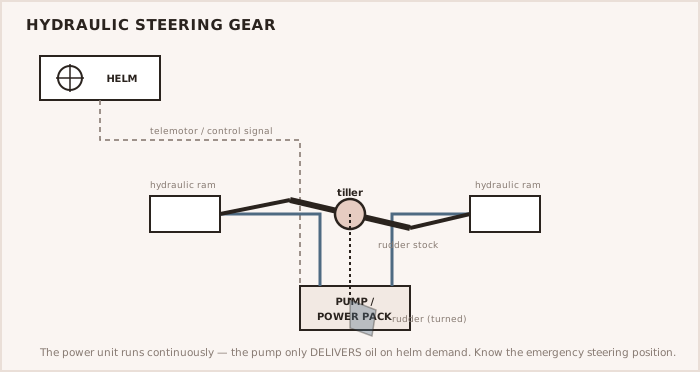
Almost always electro-hydraulic: pumps driving hydraulic rams or a rotary vane actuator on the rudder stock, with the pumps supplied from the main switchboard and — critically — supplied again from an alternative source so that a single failure does not leave the vessel unsteerable.
- Know where the steering flat is, and how to get there in the dark.
- Know how to steer locally, from the flat, on emergency control — and how long it takes you to get there from the engine room.
- Test steering before departure, through the full range, on both systems, in both control modes, with the bridge.
- Watch the hydraulic oil level. A falling level is a leak, and a leak in a steering system is a countdown.
- Know your rudder angle limits and hard-over time, because the bridge will ask.
Bilge
The bilge system removes water that has got in — from a leak, a gland, a hose, a sea, a fire hose. Suctions in each compartment, non-return valves so that one flooded space cannot flood another through the main, a strum box and strainer at each suction, a bilge pump, and often an emergency bilge suction on the main cooling water pump for flooding beyond the bilge pump's capacity.
WARNING — The bilge alarm and the strum box are what keep the vessel afloat The high bilge level alarm in an unattended space is often the very first indication a vessel has that it is sinking. It must work, it must never be inhibited, and it must be tested. And the strum box must be clear — a bilge system that cannot suck because the strainer is packed with rag and swarf is a bilge system you do not have, on the one night you need it.
Ballast
Ballast is deliberately loaded water, used to trim the vessel and manage stability. It shares pumps and pipework with bilge on many small vessels, which is precisely why the valve line-up is so important — a mis-set valve on a combined system can pump the sea into the vessel rather than out of it. Set the line-up deliberately, check it, and log it.
Free surface is the danger. A partly filled tank, or water loose across a deck, moves to the low side and takes stability with it. That is a stability problem before it is an engineering one, and it is the master's problem — which is exactly why the master needs to be told, immediately, whenever you are moving water.
The oily water separator
Engine room bilge water contains oil. Discharging it overboard untreated is a pollution offence, and the oily water separator with its oil content meter exists to keep the discharge within the permitted limit and to stop the discharge automatically when it is not.
CAUTION — Never bypass the separator, and never falsify the record Bypassing an oily water separator, and falsifying the record of what was discharged, have ended careers and put engineers in prison in multiple jurisdictions. It is not a technical shortcut; it is an offence, and the person who signs the record is the person who carries it. The record you keep must be accurate, contemporaneous and complete. The exact recording and discharge requirements that apply to your vessel and your operating area are set by the applicable pollution regulations — confirm them with AMSA and against the vessel's own certificates, and do not take a previous engineer's practice as the standard.