
Entry & progression
This is the most valuable lesson in the course. The EC3 near coastal is one of only three ways into Engineer Watchkeeper — and it is also a route that skips Engineer Watchkeeper entirely and goes straight to Engineer Class 2. Almost nobody knows the second one exists.
Australia runs two separate legal universes. Domestic vessels sit under the National Law and Marine Order 505. International — regulated Australian vessels — sit under the Navigation Act and Marine Orders 70 to 74, and that is where STCW lives. On the deck side, a domestic ticket buys you nothing at all in the international system. On the engineering side, it buys you a great deal. The EC3 is the crossing point.
Door one — the engineering experience training program
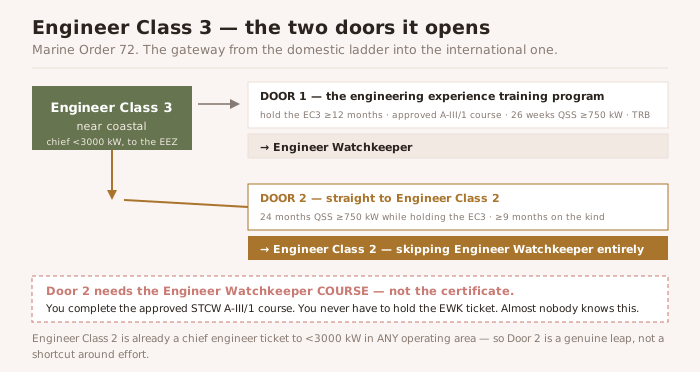
MO72 gives three training programs that lead to an Engineer Watchkeeper certificate: the engineer cadet program, the trainee engineer program, and the engineering experience training program. The third one exists for EC3 NC holders. It requires:
- You hold or have held the EC3 NC for at least 12 months;
- An approved course meeting STCW A-III/1;
- 26 weeks of QSS while holding the EC3, on vessels of at least 750 kW;
- Of which at least 16 weeks on propulsion of the kind the certificate relates to (motor or steam);
- All documented in an approved Training Record Book.
Compare that to the cadet route: three years, a 36-week workshop skills program, 36 weeks of supervised sea service. The EC3 holder does 26 weeks. The certificate you already hold is doing the work that a three-year cadetship does for someone else.
Door two — straight to Engineer Class 2
TIP — MO72 Option 2 — the course, not the certificate MO72 lists three sea service options for Engineer Class 2. Option 2 is for an EC3 NC holder: 24 months of QSS on vessels of at least 750 kW while holding the EC3, of which at least 9 months on propulsion of the kind, plus an approved Engineer Watchkeeper course (STCW A-III/1) and the short courses.
Read that again. You must complete the Engineer Watchkeeper COURSE. You do not have to hold the Engineer Watchkeeper CERTIFICATE. An EC3 NC holder can go straight to Engineer Class 2, bypassing the EWK ticket entirely. That distinction is worth years, and it is the single least-known fact in Australian marine engineering.
And Engineer Class 2 is not what people think it is either. It is already a chief engineer certificate — chief engineer on a vessel under 3000 kW in any operating area, anywhere in the world. Plus second engineer or engineer watchkeeper at any propulsion power, any area. The belief that you need Class 1 to be a chief is simply wrong below 3000 kW.
The two doors compared
| Door 1 — Engineer Watchkeeper | Door 2 — Engineer Class 2 | |
|---|---|---|
| Hold the EC3 for | At least 12 months | Throughout the QSS |
| Sea service | 26 weeks, vessels ≥750 kW | 24 months, vessels ≥750 kW |
| On propulsion of the kind | ≥16 weeks | ≥9 months |
| Course required | Approved A-III/1 | Approved EWK course (A-III/1) |
| Certificate required | — | None — the course only |
| Record | Training Record Book | Short courses, oral |
Door one is faster. Door two is bigger. Both start in exactly the same place: an EC3 near coastal in your hand, and sea time on a vessel of 750 kW or more.