
Entry & progression
A blackout is the fastest way to lose a ship. Steering gear, main engine cooling, navigation, fire pumps — all of it depends on the switchboard staying alive. Recovery is a drill, not an improvisation.
A typical vessel in the EC3's range carries two or more diesel generators, a main switchboard, distribution boards, an emergency generator with its own switchboard outside the main machinery space, and a battery-backed supply for the essentials that cannot tolerate even a momentary loss. Add shore power, an alternator on the main engine, and often an inverter or shaft generator.
The switchboard
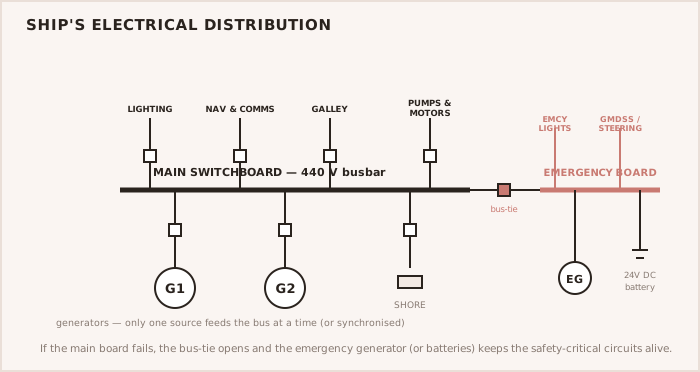
The main switchboard's job is to keep the bus alive. It carries the generator breakers with their protection — reverse power, overcurrent, under-voltage, under-frequency — the synchronising gear, and the outgoing feeders with their own protection graded so that a fault trips the smallest breaker nearest to it, not the one at the top.
That grading is called discrimination, and when it is right, a short circuit in a galley toaster trips the galley breaker. When it is wrong — because somebody fitted the wrong fuse, or defeated a trip that kept nuisance-tripping — the toaster blacks out the ship.
Paralleling
To bring a second generator onto a live bus you must match four things: voltage, frequency, phase sequence and phase angle. Close the breaker outside those conditions and you subject the machine to a violent torque transient that can shear couplings and damage windings. Most plant does this automatically now. You must still know what the synchroscope is telling you, because you will one day close a breaker manually.
WARNING — Never work live, and never trust an isolator you did not lock yourself Isolate. Lock off. Tag. Prove dead with a tester you have proved on a known source before and after — the dead test that lies is the tester that failed between the two. This is the discipline that stops experienced people being killed by circuits they thought were dead. It takes ninety seconds.
Blackout recovery
Blackout — the order of work
- Tell the bridge you have a blackout, before you start fixing it. They have to steer and warn traffic.
- Confirm the emergency generator has started and taken its board. If it has not, start it manually.
- Establish why: a tripped generator breaker, an overload, a fuel problem, a governor fault, a short circuit.
- Shed the load. Open the breakers to non-essential feeders so that the bus is not restored straight into the fault that caused the blackout.
- Start a generator and close it onto a dead bus.
- Restore essential services first — steering gear, main engine lube and cooling, navigation lights, bridge equipment.
- Then restore the rest, progressively, watching the load as it comes on.
- Restart main propulsion, and confirm with the bridge before answering telegraph.
The emergency generator
It sits outside the main machinery space, on its own switchboard, with its own fuel and its own starting system. It is the one machine on board whose entire purpose is to work on the worst day of the vessel's life — and it is the machine that gets tested least, because testing it is inconvenient.
Run it on load, on schedule, and let it get hot. Check its starting batteries and its fuel. An emergency generator that starts and then dies after ninety seconds because nobody has run it since the last survey is not a safety system. It is a decoration.