
Entry & progression
Four things go wrong in an engine room, and they go wrong fast. Fire, flooding, blackout and loss of propulsion. Everything you have learned in this course exists so that you can act in the first sixty seconds of one of them.
Engine room fire
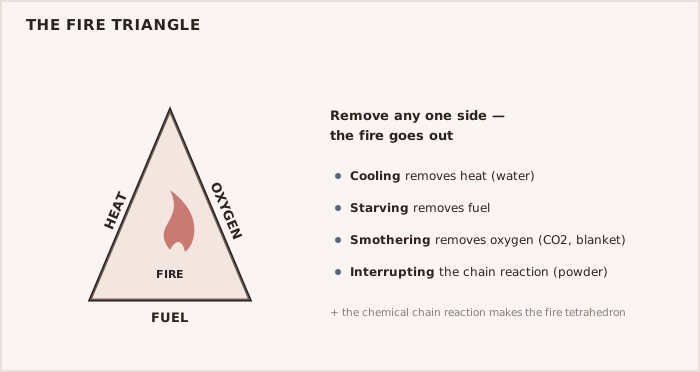
The engine room contains fuel under pressure, hot surfaces above the auto-ignition temperature of that fuel, and oxygen. A fuel line failure that sprays onto a hot exhaust is the classic marine engine room fire, and it develops with a speed people who have not seen it do not believe.
Engine room fire
- Raise the alarm and tell the bridge. First, always, before you fight anything.
- Attack it immediately if it is small and you can do so safely — the first extinguisher beats the fixed system every time.
- If it is not small: evacuate, and account for everybody. Nobody re-enters for equipment. Ever.
- Shut down the fuel — quick-closing valves, remote fuel shut-offs, tank valves.
- Stop machinery and ventilation, and close the flaps, dampers and openings. Starve it of air.
- Confirm the space is empty and sealed. Then release the fixed system, on the master's order, in accordance with the vessel's procedure.
- Do not open up. Boundary-cool the surrounding structure and leave it sealed. Re-entry re-introduces oxygen to a space full of hot fuel vapour.
WARNING — The head count is the release condition A fixed fire-extinguishing system is released into a space on the basis of one thing: that everybody is out. There is no acceptable degree of doubt. Count the people, by name, out loud, and know before you sail how many people could be in that space and how they get out of it. The drill you did not run is the head count you will not be able to complete.
Flooding
Find it, stop it, pump it — in that order, because pumping a hole you have not found is a race you lose. Most engine room flooding comes in through something you can reach: a failed hose on a raw water circuit, a shaft gland, a failed sea valve, a hull fitting. Isolate the sea suction. Get the bilge pump on it, and the emergency bilge suction if you have one. Tell the bridge immediately — flooding is a stability problem and it belongs to the master as much as to you.
Blackout
Covered in module three. The engineering response is emergency generator, find the cause, shed the load, restore onto a dead bus, essentials first. What matters in a casualty is the second half: tell the bridge before you start. A vessel that has lost steering and does not know it is a vessel that is about to hit something.
Loss of propulsion
Tell the bridge, and tell them your honest estimate of time to restore — including the estimate "I do not know yet". They are making decisions about anchoring, about drift, about tugs and about traffic, and they are making them on your number. A hopeful guess that turns out wrong is worse than an honest unknown.
The common thread
Every one of these four is a bridge problem before it is an engineering one. The instinct of a good engineer under pressure is to put their head down and fix it. Fight that instinct for the ten seconds it takes to pick up the phone, because the master cannot make a single correct decision about a vessel they believe is fine. Tell them first. Then fix it.