
Entry & progression
The AMSA task book is the highest-paid piece of paperwork in your career. On the EC3 it is worth 120 days. On the MED 1 route it is worth 180. Start it on your first day, not your last.
What it is worth
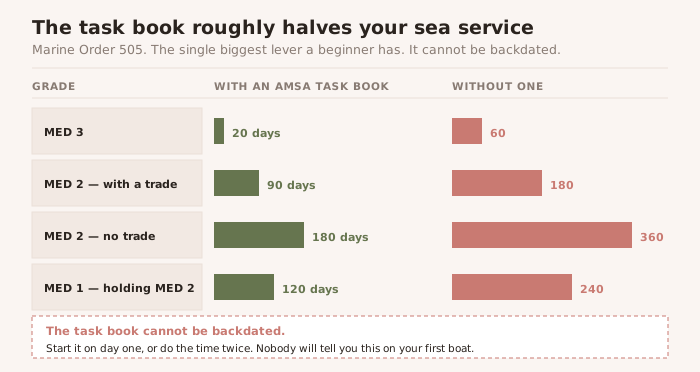
| Certificate | QSS with task book | QSS without | Days saved |
|---|---|---|---|
| EC3 NC (workshop skill equivalent) | 120 | 240 | 120 |
| EC3 NC (MED 1 NC) | 180 | 360 | 180 |
| MED 1 NC (holding MED 2) | 120 | 240 | 120 |
| MED 2 NC (workshop skills) | 90 | 180 | 90 |
| MED 3 NC | 20 | 60 | 40 |
Look at the pattern. At every rung, without exception, the task book halves the requirement. Six months of your life at the EC3 level, on the MED 1 route. If you are paid a day rate, put a number on that. If you are not, put your twenties on it.
WARNING — You cannot backfill a task book The task book records tasks performed and witnessed. A signature on a competency you completed eleven months ago, given by an engineer who has since left the vessel and cannot honestly attest to it, is not evidence — and asking for it puts a professional in an ugly position. Engineers who start the book late almost always end up serving the long-form sea time anyway. Order the book from AMSA before you join.
The Engineer Watchkeeper exception
There is exactly one route to the EC3 where the task book does not change the number: the Engineer Watchkeeper route is at least 90 days either way. That is not a loophole to exploit — it simply reflects that an EWK holder has already produced a Training Record Book to get their STCW certificate. They have done the structured evidence once.
Who signs it
Sign-off comes from a competent, certificated person on board — in practice the chief engineer, or on a larger plant the second. Which means the vessel you choose determines whether the book progresses at all. A vessel with no certificated engineer above you is a vessel where your task book stalls.
That single fact should shape your first two years. Take the berth with a chief who will teach and sign, over the berth that pays a hundred dollars more a day and leaves you as the only person in the engine room. Sea time accrues either way. Competency, and the evidence of it, does not.
Discipline
- Order the task book from AMSA before you join the vessel.
- Get tasks signed the week they happen, not at the end of the trip.
- Photograph or scan every completed page as you go — books get lost, and there is no backup.
- Keep the task book and your sea service letters as two separate records. They prove different things.
- Confirm the engine plate reads 400 kW or more, inboard diesel, before you count the day.