
Entry & progression
Cooling is the fastest-acting failure in the engine room. Fuel contamination stops an engine. Cooling failure destroys one. The interval between the first symptom and a seized unit is measured in minutes.
Almost every marine diesel above a few hundred kilowatts is indirectly cooled. A closed fresh water circuit — treated, corrosion-inhibited, at a controlled temperature — takes heat out of the engine jackets, heads and oil cooler. That circuit is then cooled by seawater in a heat exchanger, or by a keel cooler in contact with the sea. The seawater never touches the engine, and that is deliberate: salt water in an engine jacket destroys it.
The seawater side, in order
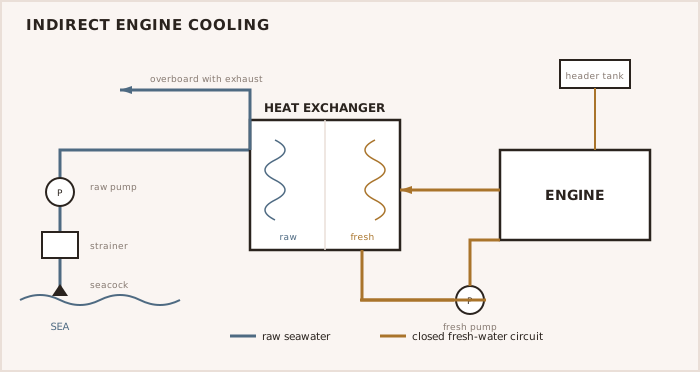
- Sea chest with a strainer and a ship's-side valve
- Suction strainer — the basket you actually clean
- Seawater pump — engine-driven, with a rubber impeller on smaller plant
- Heat exchangers — jacket water cooler, lube oil cooler, charge air cooler, gearbox cooler
- Overboard discharge — often through the exhaust, which gives you a free indicator
TIP — Water at the exhaust is a free, continuous cooling alarm On a wet-exhaust installation, the water coming out of the transom tells you the seawater pump is turning and the circuit is clear — for free, every second the engine runs. Teach the deck crew to look at it. A crew member who reports that the water has stopped has just saved the engine, and they do not need to know anything about diesels to do it.
What fails, and in what order
- Blocked strainer — weed, plastic, a jellyfish, a shopping bag. First and most common.
- Failed impeller — perishes with age, shreds instantly if run dry. The pieces then lodge in the heat exchanger downstream, so you must account for every vane.
- Fouled heat exchanger — scale, silt and marine growth in the tube stack. Progressive, and it shows as a slow upward creep in jacket temperature.
- Corroded tube stack — eventually a leak, which puts salt water into your fresh water circuit.
- Sacrificial anodes consumed — and then the tube stack starts corroding. Anodes are the cheapest component in the engine room and the most often forgotten.
The fresh water side fails differently and more slowly: a low header tank level, a failed thermostat that will not open, a slipping belt on the circulating pump, or an air lock after a job. Depleted corrosion inhibitor causes damage that never announces itself until the day you open the engine.
The response to a high jacket temperature
High cooling water temperature alarm
- Reduce load. Immediately. Tell the bridge — do not ask permission first, tell them what you are doing and why.
- Check the header tank level and the seawater discharge. Two checks, ten seconds, and between them they diagnose most of it.
- Check the strainer. If it is blocked and you can change to the standby, do so.
- Check the belt, the impeller and the thermostat, in that order of ease.
- If the temperature keeps rising, stop the engine — before it seizes, not after.
- Let it cool before you open anything. Removing a hot pressure cap has blinded people.
Why you do not just top up and carry on
A fresh water circuit that needs topping up is a circuit that is leaking, and the two places it may be leaking to are overboard, where it is merely embarrassing, and into the engine, where it is fatal. Water in the sump is not a top-up problem. Find where it went before you decide it is nothing.