
Entry & progression
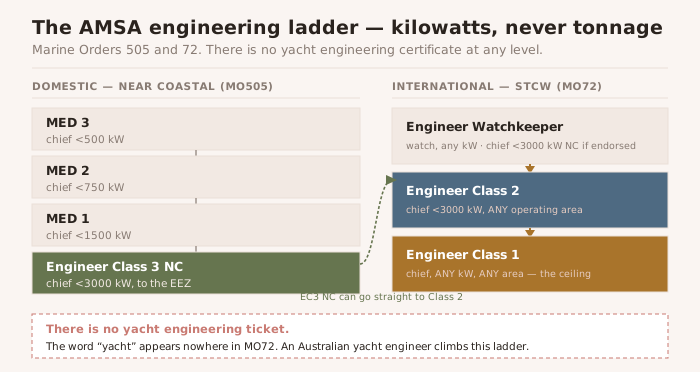
Engineer Watchkeeper is the first STCW engineering certificate AMSA issues. It sits under Marine Order 72 (Engineer officers) 2014. Above it: Engineer Class 2, then Engineer Class 1. Nothing sits above Engineer Class 1.
Australia does have a yacht order — Marine Order 74 — and its purpose clause says it specifies the standards to be attained by a qualified master or deck officer. Its Schedule 1 lists four grades. All four are deck. An Australian yacht engineer therefore holds a general engineer officer certificate, exactly the same one held by an engineer on a bulk carrier. Engineer Watchkeeper is where that starts.
What the certificate entitles you to do
MO72 Schedule 1. Read it slowly, because two different ceilings are hidden in it.
- Engineer watchkeeper duties on a seagoing vessel of any propulsion power, of the kind stated on the certificate, in any operating area
- If endorsed: second engineer duties on a vessel <3000 kW, in any operating area
- If endorsed: chief engineer duties on a vessel <3000 kW, in near-coastal waters
- Electrical, electronic and control engineering duties
- Able seafarer — engine rating duties
The first line is the remarkable one. As a watchkeeper there is no power ceiling at all. The certificate does not care whether the main engine is 900 kW or 90,000 kW. It cares what kind of engine it is, and it cares that you keep the watch, not that you run the department.
WARNING — Kilowatts. Never gross tonnage. There is no GT figure anywhere in MO72. Not one. The deck ladder is scoped in gross tonnage; the engineering ladder is scoped in kilowatts — 375, 400, 500, 750, 1500, 3000 kW.
"Engineer <3000 GT" is not a certificate. It has never existed. If you see that phrase in a recruitment ad, a forum post or a CV, whoever wrote it has imported the deck ladder's units into the engine room. Correct it.
The two ceilings
The second engineer endorsement is capped by power alone: <3000 kW, any operating area. The chief engineer endorsement is capped by power and geography: <3000 kW, near-coastal only. Chief engineer is the tighter of the two, and it is the one that stops you.
To be chief engineer beyond near-coastal waters you need Engineer Class 2, which is already a chief engineer ticket up to <3000 kW in any operating area. The common belief that you need Class 1 to be a chief is simply wrong below 3000 kW.
CAUTION — "Near-coastal" is a defined term, and the definition matters Marine Order 505 — the domestic instrument — defines near coastal as waters out to the outer limits of Australia's exclusive economic zone. That is a much larger area than most people assume, and it is not a fixed number of nautical miles. Which definition attaches to the MO72 chief engineer endorsement was not confirmed for this course. Check the operating-area definition with AMSA before you rely on it.
The certificate does not ask how big the engine is. It asks what kind it is, and whether somebody who held a ticket was willing to sign your book.