
Entry & progression
Your certificate says Motor. This is what Motor means. Two-stroke and four-stroke, the cycle, and — the part that keeps you employed — what actually goes wrong, and what it tells you before it does.
Two-stroke and four-stroke
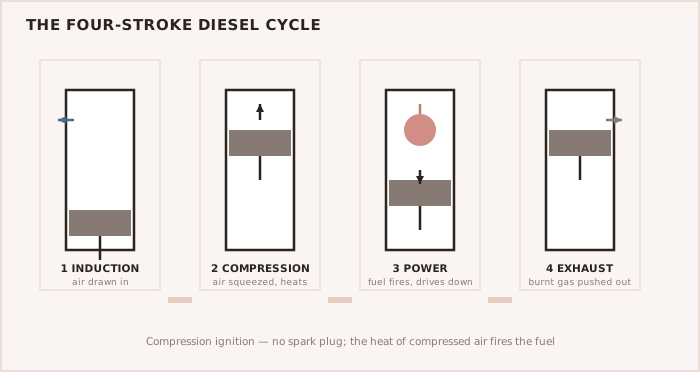
| Two-stroke | Four-stroke | |
|---|---|---|
| Power stroke | Every revolution | Every second revolution |
| Typical speed | Slow-speed, 60–250 rpm | Medium/high-speed, 500–2000 rpm |
| Gearbox | Usually direct-coupled to the shaft | Almost always through a reduction gearbox |
| Scavenging | Uniflow, via ports and an exhaust valve | Valve overlap, inlet and exhaust valves |
| Where you meet it | Large merchant tonnage | Yachts, generators, almost everything else |
A yacht engineer lives in the four-stroke world. Main engines and generators alike are medium- or high-speed four-strokes, and they are less forgiving of bad fuel and bad maintenance than a slow-speed two-stroke, because they run three to ten times faster.
Reading the engine
An engine tells you what is wrong long before it stops. The skill is not fixing engines. It is noticing.
- Exhaust temperature deviation on one unit — a high reading suggests late or excessive fuel, a fouled turbocharger, or a burning valve; a low reading suggests a fuel injector or fuel pump not delivering
- Rising scavenge air temperature — the air cooler is fouled or the seawater side is blocked, and every degree of charge air temperature is power you are not making
- Falling turbocharger revolutions with no change in load — fouled nozzle ring or turbine blades
- Turbocharger surging — a rhythmic barking from the blower. Fouled turbine, restricted air filter, or the engine is being loaded faster than it can breathe
- Blow-by past the piston rings — smoke or pressure at the crankcase breather, and a loss of compression you will see in the exhaust temperatures
- Water in the lube oil — a cracked liner, a leaking cooler, or a failing seal. The oil goes milky and the bearings go next
The two that kill people
WARNING — Crankcase explosion — and why you wait A hot bearing vaporises lube oil into a fine mist inside the crankcase. That mist is an explosive fuel-air mixture. The first explosion may be modest; the second, when fresh air rushes in through the hole the first one made, is the one that kills.
So: oil mist detectors and crankcase relief doors are fitted, and the standing rule is absolute. On an oil mist alarm or a suspected hot bearing: reduce load, stop the engine, and DO NOT open the crankcase for at least 30 minutes. Let it cool. Do not stand in front of a relief door. Do not "just have a quick look".
Engineers have died opening a crankcase early. It is a well-documented way to be killed by a machine you were trying to help.
The other is the scavenge fire — unburnt fuel and carbonised lube oil accumulating in the scavenge spaces, ignited by blow-by. Symptoms: a rise in scavenge temperature, surging, a loss of power, and paint blistering off the scavenge trunk. Reduce load, stop fuel to the affected unit, shut off the scavenge drains, and smother — do not open up to look.
Diesel engines are not fragile. They are patient. They will run for a decade on indifferent maintenance and then take everything back in one afternoon.