
Entry & progression
Everything the engine burns, the cooling system carries away. Roughly a third of the fuel's energy leaves as heat through the coolers. Lose the seawater and you lose the ship's propulsion in minutes, not hours.
Central cooling — the standard layout
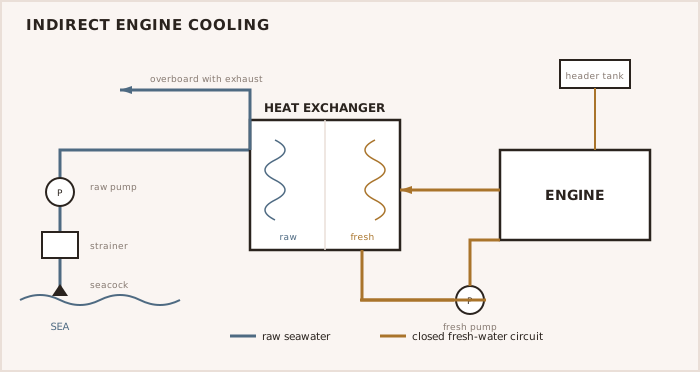
Two circuits, meeting at a heat exchanger. Seawater is drawn from a sea chest, pumped through the central cooler, and discharged overboard. Fresh water — treated, closed, recirculating — takes the heat from the engine jackets, the lube oil cooler, the charge air cooler and the generators, and gives it to the seawater at the central cooler.
The point of keeping seawater out of the engine is corrosion. Seawater in a jacket is a slow-motion write-off.
The seawater side
- Sea chests — high suction and low suction. High when in shallow, silty or ice-strewn water; low when deep and clean. Knowing when to change over is watchkeeping, not maintenance
- Sea strainers — the first thing to check on any cooling alarm, and the thing that blocks with weed, jellyfish and plastic. Clean them on a schedule, not on an alarm
- Seawater pumps — with a standby, which you test
- Anodes — sacrificial zinc or aluminium in coolers and boxes. If nobody has changed them in two years, they are gone and the tube plates are next
The fresh water side
- Expansion tank — check the level daily. A falling level is a leak, and a leak into the lube oil is an engine
- Thermostatic valve — holds jacket water outlet temperature steady. Too cold is not safe, it is corrosive: cold liners condense sulphuric acid
- Water treatment — nitrite level and pH, tested to schedule. Untreated jacket water pits liners and destroys cooler tubes
- Header vents — air in the system means hot spots and cavitating pumps
WARNING — Loss of cooling is a slow-down, immediately On rising jacket water or lube oil temperature that you cannot correct: reduce load and tell the bridge, at once. Do not chase the fault at full power hoping to catch it.
An engine run hot will seize a piston, crack a head or wipe a bearing, and it will do it without warning. A yacht that arrives an hour late is a yacht that arrives. The bridge cannot make an informed decision about a coastline you have not told them about.
Yacht-specific realities
Yachts anchor in exactly the water that blocks strainers — shallow, warm, weedy, full of plastic and sand. They also sit for weeks with the seawater system stagnant, which breeds fouling in the pipework and the coolers themselves. And they run generators hard at anchor with the main engines cold, which loads the seawater system in a way the designer may not have assumed.
So the seawater system on a yacht does more work, in worse water, with longer idle periods, than the designer's duty cycle assumed. Treat the strainers as a daily item in season, not a monthly one, and log the condition you find them in — a strainer that is filling faster each day is telling you something about the anchorage before it tells you something about the engine.
Check the strainers before the guests arrive, not after the air conditioning fails at anchor in August.