
Entry & progression
The engine room contains every element of the fire triangle, permanently, by design. Fuel under pressure, surfaces above its ignition temperature, and a ventilation system supplying air. Prevention is not a poster. It is the job.
Prevention
- Lag and shield every hot surface above 220 °C — exhaust manifolds, turbochargers, uptakes. Check that the lagging is intact and oil-free. Oil-soaked lagging is not insulation; it is a wick
- High-pressure fuel lines must be jacketed — double-walled, with the leakage drained to a tank fitted with an alarm. If that alarm sounds, you have a fractured pipe. Do not silence it
- Chase every leak. There is no such thing as a small oil leak in an engine room, only an oil leak you have not yet been punished for
- No oily rags. Not on the manifold, not in a bucket, not anywhere. They start fires without any help
- Keep the bilges clean. An oily bilge is a fuel tray under the machinery
The fixed system
Total-flooding CO2, high-expansion foam, or water mist. All three work by removing something the fire needs, and all three require the space to be sealed first. A fixed system released into a ventilated space achieves nothing at all.
Fixed system release — the sequence that must not be shortened
- Raise the alarm. The whole ship, at once
- Evacuate the space — and account for every person by name. Not by count. By name
- Stop the machinery — main engines, generators, purifiers, boilers
- Operate the remote fuel shut-offs and the quick-closing valves to every tank, and stop the fuel and lube oil pumps from outside the space
- Stop the ventilation fans. Close the dampers, skylights, doors and funnel flaps. Seal it
- Confirm the headcount again. This is the last moment at which you can stop
- Release the fixed system from the release station outside the space, on the master's order
- Boundary-cool. Water on the bulkheads and the deck above, and keep it there
- Do not open up. Not to look. Not to check. The space stays shut for hours, and it is reopened only when it is cold and on a considered decision with a boundary cooling and re-entry plan in place
WARNING — Reopening a hot space is how a controlled fire becomes a fatal one CO2 does not cool. It displaces oxygen. The steel, the oil and the machinery in that space remain far above the auto-ignition temperature of fuel oil for a long time after the fire is out.
Open the door and you re-admit air to a hot, fuel-rich space. It will re-ignite, and it will re-ignite into the faces of the people standing in the doorway.
Wait. Cool the boundaries. Prove it is cold. Then decide.
Before it ever gets that far
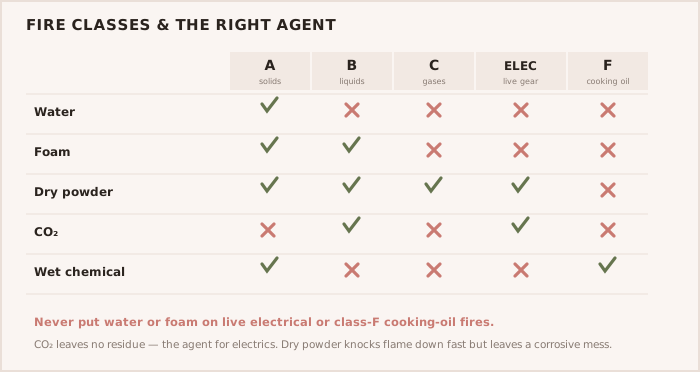
Your first-response tools are portable extinguishers, the fire main and — for a small, contained oil fire — foam. Attack early, from a safe position, with an escape route behind you. A fire caught in the first minute is an incident. A fire caught in the fifth is a total flood.
Know where the quick-closing valve levers are. In the dark. Without counting doors. You will not have a torch and you will not have time.