
Entry & progression
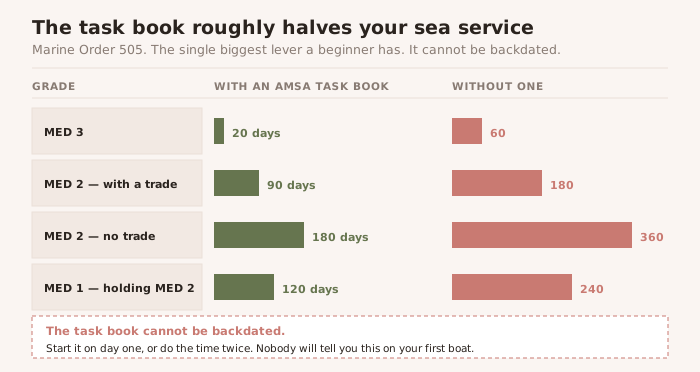
The task book roughly halves the required sea service at every grade. It is free, it is administrative, and it is the largest single saving available to anyone starting an Australian engineering career. Start it on day one or do the time twice.
AMSA publishes two sea service figures for every domestic certificate: one for candidates working through a task book, and a much larger one for candidates who are not. The gap is not a rounding error.
The whole ladder, in one table
| Certificate | With task book | Without | Ratio |
|---|---|---|---|
| MED Grade 3 | 20 days | 60 days | 1:3 |
| MED Grade 2 - with workshop skills | 90 days | 180 days | 1:2 |
| MED Grade 2 - without workshop skills | 180 days | 360 days | 1:2 |
| MED Grade 1 - holding MED 2 | 120 days | 240 days | 1:2 |
| MED Grade 1 - holding workshop skills | 90 days | 180 days | 1:2 |
Every row halves. At Grade 3 it does better than halve - twenty days against sixty. There is no square in that table where being without a task book is anything other than a straightforward loss of your own time.
Why the discount exists
It is not a reward for paperwork. The days-without figure is what AMSA needs to be confident, from duration alone, that you have probably seen enough. The days-with figure is what AMSA needs when it has evidence of what you actually did. Sixty undocumented days tell the regulator very little. Twenty documented, signed-off days tell it a great deal. The task book is not administration. It is the evidence.
CAUTION — A task book cannot be backdated The saving applies to service completed while keeping the task book. Days worked before you had one are, at best, days on the without-task-book count.
The classic mistake is to work a season, decide you like it, and then apply for a task book. That season now counts at the slow rate. Apply for the task book before you join your first vessel. It is the cheapest decision in this course.
Working it properly
Getting the days to count
- Apply to AMSA for the task book before your first sea day. Not after the first trip, not at the end of the season.
- Read the whole book on day one. The tasks tell you what the certificate expects. They are the actual syllabus of the job.
- Identify who can sign. Find out early who aboard is qualified to sign off your tasks, and tell them you have a book. People are far more helpful when they are not ambushed on the last day of a swing.
- Get the signature when the task is done, not months later. Engineers leave vessels. An unsigned task is an unrecorded one.
- Keep the sea service record in parallel. The task book proves competence; the sea service letter proves days. They are two different documents and AMSA wants both.
The money version of the argument
Sixty days of unpaid or badly paid entry-level sea time, versus twenty. Three hundred and sixty days versus ninety. At the bottom of this ladder the difference between having a task book and not having one is a year of your working life. It is the single biggest lever a beginner has, and it is available on day one to somebody with no certificate, no trade and no experience.