
Entry & progression
A marine engine is cooled by the sea, and the sea is trying to destroy everything it touches. The cooling system is where corrosion, blockage and neglect meet - and it is the fault a new engineer will meet first.
Two systems, and the difference matters
| Raw water (direct) | Closed circuit (indirect) | |
|---|---|---|
| What circulates in the engine | Seawater itself | Fresh water and coolant/inhibitor |
| Advantage | Simple, cheap, few parts | Engine internals never see salt; runs hotter and more efficiently |
| Disadvantage | Salt corrodes and scales the engine internally; must run cool | More components - heat exchanger, two pumps, two circuits |
| Where you find it | Older and smaller engines, outboards | Almost every modern inboard diesel |
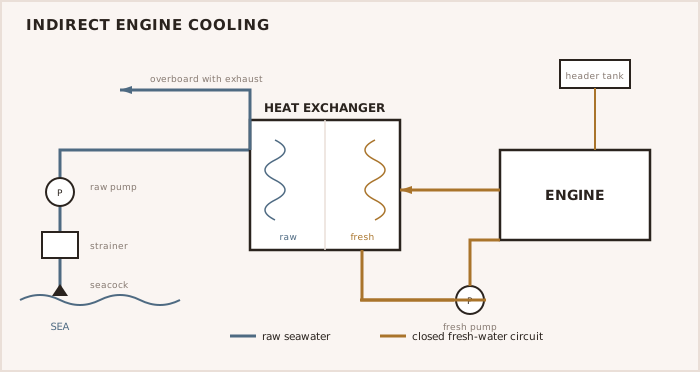
In a closed-circuit engine there are two water circuits. The inner one - fresh water with corrosion inhibitor - circulates through the engine block and takes the heat away. The outer one - raw seawater - is drawn in through the hull, pumped through a heat exchanger where it takes the heat out of the fresh water, and then dumped overboard, usually through the exhaust. The two never mix. If they ever do, you have a failure.
The raw water path - and every place it blocks
- Seacock - the valve in the hull. Closed is a classic post-maintenance error.
- Strainer - a basket you can see into. Weed, plastic bags, jellyfish, sand.
- Impeller pump - a rubber impeller in a housing. It is the weak link, by design.
- Heat exchanger - the tubes silt up and scale.
- Exhaust injection point - raw water is injected into the exhaust to cool it and to carry it overboard.
- Overboard discharge - the reason you look over the side to check for water flow.
CAUTION — No water at the exhaust is an immediate problem On a wet exhaust, the raw water is what stops the exhaust hose from melting and the engine from cooking. If the discharge stops, you have minutes - not hours - and the first casualty is usually the impeller, then the exhaust hose, then the engine.
Look over the side. It is the single most useful ten-second check in the engine room, and it is done from the deck.
The impeller
The raw water pump uses a flexible rubber impeller running in an off-centre housing. It is self-priming, cheap, and it is destroyed by running dry for even a few seconds. Vanes tear off, travel downstream, and lodge in the heat exchanger. When you change an impeller, count the vanes. Any that are missing are somewhere in your system, and you have to find them.
Carry spare impellers. Carry the gasket. Learn to change one before you need to change one in a seaway.
Overheating - the order of the checks
Engine overheating
- Reduce load or stop. Heat is a function of load. Come off the throttle first, then decide.
- Look over the side. Is raw water discharging? This one look splits the diagnosis in half.
- No discharge: check the seacock is open, the strainer is clear, and the impeller is intact. That sequence, in that order.
- Discharge present: the raw water side is working, so suspect the fresh water side - coolant level, thermostat, belt, or a fouled heat exchanger.
- Never open a hot pressure cap. The coolant is above its atmospheric boiling point and will flash to steam in your face. Let it cool.
- Log it, and tell the bridge. An engine that overheated once will overheat again.