
Entry & progression
Everything else in this course sits on top of this lesson. The AMPA will ask you to explain what the engine is doing. If you cannot describe the cycle, you cannot diagnose a fault in it - you can only guess.
A diesel engine does one thing: it converts the heat of burning fuel into rotation. It does it by trapping air in a cylinder, squeezing that air hard enough to make it hot, and then injecting fuel into it. The heat of compression - not a spark - is what lights the fuel. That single fact is the whole difference between a diesel and a petrol engine, and almost every diesel fault traces back to it.
The four strokes
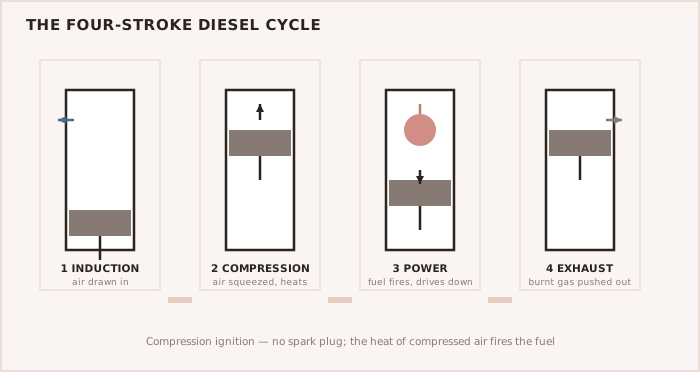
| Stroke | Piston | Valves | What is happening |
|---|---|---|---|
| 1. Induction | Down | Inlet open | Air is drawn into the cylinder. Air only - no fuel. |
| 2. Compression | Up | Both shut | The air is squeezed to a small fraction of its volume, and its temperature rises far above the ignition point of diesel. |
| 3. Power | Down | Both shut | Fuel is injected as a fine mist near the top. It ignites on contact with the hot air, and the expanding gas drives the piston down. This is the only stroke that produces work. |
| 4. Exhaust | Up | Exhaust open | The burnt gas is pushed out. |
Four strokes, two revolutions of the crankshaft, one power stroke. Three of the four strokes are paid for by the flywheel and by the other cylinders. That is why a single-cylinder engine shakes and a six-cylinder engine does not.
Compression is everything
Ignition depends entirely on the air getting hot enough. Anything that lets compression escape - worn rings, a burnt valve, a blown head gasket, a scored liner - lowers the peak temperature, and the engine becomes hard to start, smoky, and down on power. This is why a diesel that will not start on a cold morning but runs fine once warm is telling you about its compression, not its fuel.
What the smoke is telling you
| Colour | Usually means |
|---|---|
| Black | Too much fuel for the air available. Blocked air filter, fouled turbo, overloaded engine, bad injectors. |
| Blue | Burning lubricating oil. Worn rings, worn valve guides, overfilled sump. |
| White | Fuel or water not burning. Cold engine, poor compression, water in the fuel, or - the serious one - coolant entering a cylinder. |
TIP — Learn what your engine looks like when it is well Every diagnostic in this course is a comparison. Normal exhaust colour, normal exhaust temperature, normal oil pressure at idle and at load, normal coolant temperature, normal sound. If you have never consciously looked at the healthy state, you will not recognise the sick one.
Write the normal figures down. Put them in the log. That page is worth more at three in the morning than any manual aboard.
Two-stroke, briefly
Some marine diesels - and most older outboards - complete the cycle in two strokes: every downstroke is a power stroke, and scavenging and exhaust happen together around bottom dead centre. It gives more power for a given size and burns more fuel and oil doing it. The combustion principle is identical. It is the gas exchange that differs.
Learn the four-stroke cycle until you can draw it. Everything in Module 2 - fuel, lubrication, cooling - exists to keep those four strokes happening cleanly, and every failure in Module 2 is a failure of one of them.