
Entry & progression
Marine Engine Driver Grade 3 has no prerequisite certificate. You do not need a ticket to start. You need to be 16, hold a first aid certificate, pass a medical, and do the days. This lesson is the map of everything above that.
Australia certifies engineers by kilowatts. Not by gross tonnage, not by length. A deck officer's world is measured in metres and tonnes; an engineer's world is measured in power. Every ceiling on every engineering certificate in this country is a kW figure. If you ever see "Engineer under 3000 GT" written down, someone has invented it. That certificate does not exist.
Two systems, one country
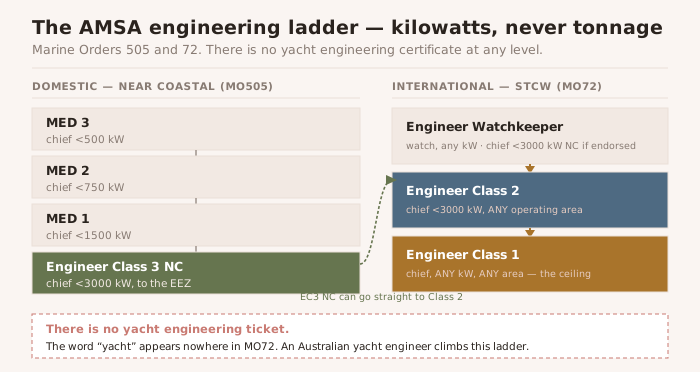
Australia runs two separate certification regimes under two separate Acts. The domestic system covers domestic commercial vessels and is set by Marine Order 505. The international system covers regulated Australian vessels, is set by Marine Orders 70 to 74, and is the one that carries STCW recognition. The Marine Engine Driver grades are domestic. They live entirely inside MO505.
The domestic engineering ladder
| Grade | Chief engineer, inboard | Second engineer | Final assessment |
|---|---|---|---|
| MED Grade 3 NC | under 500 kW | under 750 kW | AMPA |
| MED Grade 2 NC | under 750 kW | under 1500 kW | AMPA |
| MED Grade 1 NC | under 1500 kW | under 3000 kW | AMSA oral exam |
| Engineer Class 3 NC | under 3000 kW | - | Final assessment |
Four rungs, from nothing to chief engineer of a 3000 kW ship inside the exclusive economic zone. Above Engineer Class 3 the domestic ladder stops and the international one begins: Engineer Watchkeeper, Engineer Class 2, Engineer Class 1. Engineer Class 3 near coastal is the joint between the two systems. Everything in this course is below that joint.
Near coastal is bigger than it sounds
MO505 defines near coastal as waters including inland waters and waters to the outer limits of Australia's exclusive economic zone. There is no nautical-mile figure. Near coastal is not the harbour. It is two hundred miles out, all the way around the continent.
The two things nobody tells a beginner
TIP — The task book roughly halves your sea service. Start it on day one. At every grade, AMSA publishes two sea service numbers: one for candidates keeping an AMSA task book, and a much larger one for candidates who are not. MED 3 is 20 days with a task book, 60 days without. That ratio holds all the way up the ladder.
The task book cannot be backdated. Days you work before you open it are days you may have to work again. Get it before your first sea day, not after your fiftieth.
The second thing: your entitlement on outboard engines is unlimited power at every grade, including Grade 3. The kW ceilings above apply to inboard engines only. A brand new MED 3 can be chief engineer of an outboard-powered vessel of any power at all. It is counter-intuitive, it is in the schedule, and it shapes where the work is.
A note for yacht readers
CAUTION — Gensets and thrusters versus propulsion power - confirm this with AMSA The international order, MO72, scopes engineer certificates by main propulsion machinery and treats auxiliary machinery run independently of main propulsion differently. On that definition a yacht's generators and thrusters are not propulsion power, and a yacht with big gensets is not thereby a big-kW vessel.
That is the MO72 definition. MO505 - the order that governs the MED grades - is not quoted to that effect in our source base, and we will not claim it is. If the difference decides whether a vessel is inside or outside your ticket, ask AMSA in writing before you sign anything.