
Entry & progression
The engine room kills more people with electricity than with anything else. Not because the voltages are exotic, but because the space is wet, earthed, and full of metal. Isolation is not a formality. It is the whole of your safety.
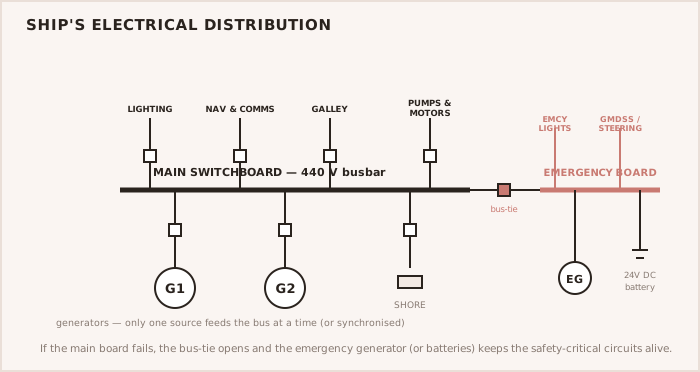
A small commercial vessel typically runs two electrical systems side by side: a DC system at 12 or 24 volts, for starting, instruments, lighting and electronics; and an AC system - shore power, or a generator - for domestic loads, workshop tools, galley and air conditioning. They are separate systems with separate hazards, and the one that will kill you is the AC.
Where the power comes from
- The alternator - belt-driven off the main engine. Charges the batteries whenever the engine runs. If the belt is loose, the batteries are not charging, and the first you know of it is a flat bank.
- The generator (genset) - a small diesel driving an alternator, producing AC independently of the main engine.
- Shore power - AC from the dock. It brings the dock's earth aboard with it, which is why galvanic isolation and correct earthing matter so much alongside.
- The batteries - not a source. A store. They only give back what something else put in.
Batteries
Most vessels split the bank: a start battery, kept fully charged and used for nothing else, and a house or service bank, which is deep-cycled. The reason is simple and it is the point of the whole arrangement: you can always start the engine, no matter what the crew have left switched on. Never lose that separation to a convenience wiring job.
WARNING — Charging batteries give off hydrogen Lead-acid batteries under charge produce hydrogen gas, which is explosive over a wide range of concentrations and needs almost no energy to ignite. Battery compartments must be ventilated, and the last place you make or break a connection is at the battery terminal - a spark there is a spark in the gas.
The electrolyte is sulphuric acid. Eye protection is not optional, and fresh water for flushing must be to hand before you start work, not fetched afterwards.
Isolation - the discipline that keeps you alive
Before working on any electrical equipment
- Identify every source of supply to the equipment. Shore power, generator, inverter, batteries, and any automatic transfer. More than one has killed more than one.
- Isolate them all at the breaker or isolator switch.
- Lock it off and tag it. Physically prevent the switch being closed, and put your name on the tag with the date and the reason.
- Prove dead at the point of work with a tester you have proved works before and after - on a known live source.
- Only then start work.
The step people skip is proving dead. A breaker labelled for one circuit and wired to another is not a rare thing on a boat that has been refitted three times. Test, do not trust the label.
TIP — Never isolate a running system without telling the bridge The bilge pumps, the navigation lights, the steering, the fire pump and the engine alarms are all electrical. Pulling a breaker to work in peace can quietly disable something the vessel is depending on right now.
Tell the bridge what you are isolating and for how long. Every time. It costs thirty seconds.
What you look for on a round
Hot cables, hot terminals and hot breakers - heat means resistance, and resistance means a loose or corroded connection working its way towards a fire. Green corrosion at terminals. Chafe where a cable crosses a bulkhead. A tripped breaker that someone has reset without asking why it tripped. Any of these is a fault in progress.